World Stroke Day is observed every year on October 29 to raise awareness about stroke prevention, warning signs, treatment, and life after stroke. In 2026, the World Stroke Organization’s campaign is called “Every M1nute Counts,” built around the message to know the signs of stroke and #ActFAST.
| Fact | Answer |
|---|---|
| World Stroke Day 2026 | October 29, 2026 |
| Day | Thursday |
| 2026 Campaign | Every M1nute Counts |
| Campaign Focus | Stroke symptom awareness |
| Key Action | #ActFAST |
| Organizing Body | World Stroke Organization |
| Main Purpose | Stroke awareness, prevention, and rapid symptom recognition |
If you’re planning ahead for other awareness dates and observances this year, our 2026 holiday calendar covers many of the dates worth marking.
When Is World Stroke Day 2026?
World Stroke Day 2026 falls on Thursday, October 29. The date is fixed every year — World Stroke Day is always observed on October 29, regardless of the day of the week it lands on.
What Is the World Stroke Day 2026 Theme?
The World Stroke Organization’s 2026 campaign message is “Every M1nute Counts. Know the signs of stroke. #ActFAST.” The campaign centers on helping people recognize stroke symptoms quickly and understand why immediate emergency care matters so much.
What Is the #ActFAST Message?
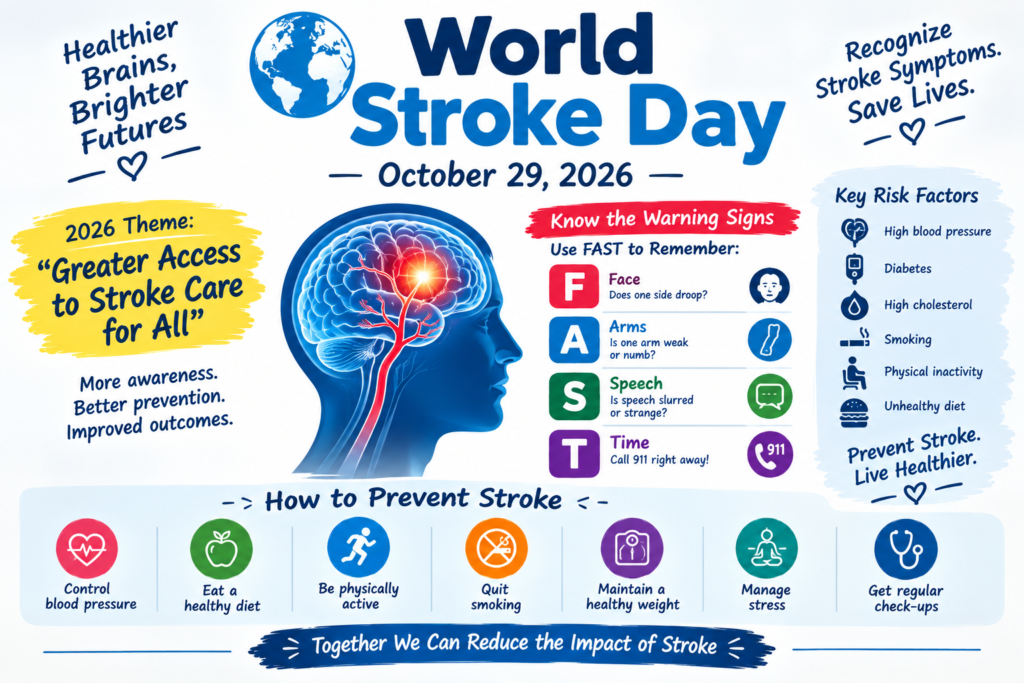
FAST is a simple way to remember the most common early warning signs of stroke:
| Letter | Warning Sign |
|---|---|
| F | Face — does one side of the face droop? |
| A | Arms — is one arm weak or numb? |
| S | Speech — is speech slurred or unusual? |
| T | Time — call emergency services immediately if these signs appear |
Beyond FAST, stroke symptoms can also include sudden vision problems, dizziness or loss of balance, confusion, and a sudden, severe headache.
What Is World Stroke Day?
World Stroke Day was established to draw global attention to stroke as a serious and often preventable health emergency. The World Stroke Organization coordinates the observance each year, working with national stroke societies, hospitals, and health organizations to promote awareness, encourage prevention, support early symptom recognition, and highlight the ongoing needs of stroke survivors.
Why Is the 2026 Theme “Every M1nute Counts”?
Why Time Matters During a Stroke
During a stroke, brain tissue can be affected very quickly once blood flow is interrupted, which is why healthcare organizations consistently emphasize acting without delay. The longer treatment is delayed, the more limited the options for minimizing long-term damage tend to become.
Why Recognizing Symptoms Quickly Matters
Many people either don’t recognize stroke symptoms or wait to see if they pass. The “Every M1nute Counts” campaign is built specifically around closing that gap — helping ordinary people, not just healthcare workers, know what to look for and act right away.
How Public Awareness Can Reduce Delays
Campaigns like FAST exist because simple, memorable checklists tend to help people respond faster than trying to recall a longer list of symptoms. Wider public familiarity with FAST is one of the more effective tools stroke organizations have for cutting down on treatment delays.
Why Is World Stroke Day Celebrated?
World Stroke Day serves several connected purposes:
- Raising awareness of stroke symptoms
- Encouraging prevention through healthy lifestyle choices
- Promoting rapid emergency response when symptoms appear
- Improving public understanding of stroke risk factors
- Highlighting rehabilitation and life after stroke
- Supporting stroke survivors and their caregivers
- Encouraging better access to stroke care globally
What Is a Stroke?
The World Stroke Organization coordinates the observance each year occurs when blood flow to part of the brain is interrupted, either by a blockage or by bleeding. Because brain cells need a constant blood supply to function, this interruption can cause rapid and serious effects depending on which part of the brain is affected.
What Are the Main Types of Stroke?
| Type | What Happens |
|---|---|
| Ischemic stroke | A blood vessel supplying the brain becomes blocked |
| Hemorrhagic stroke | A blood vessel ruptures and causes bleeding in or around the brain |
| Transient ischemic attack (TIA) | Temporary stroke-like symptoms caused by a brief blockage |
A TIA is sometimes called a “mini-stroke,” but it should never be treated as harmless — it’s often a warning sign that a full stroke could follow, and it still requires prompt medical evaluation.
What Are the Warning Signs of a Stroke?
Common stroke warning signs include sudden facial drooping, weakness or numbness — especially on one side of the body — speech or understanding difficulties, vision problems, dizziness or loss of balance, and a sudden, severe headache. Stroke symptoms require immediate medical attention.
Other Possible Stroke Symptoms
- Sudden numbness, especially on one side of the body
- Sudden confusion or trouble understanding others
- Sudden difficulty seeing in one or both eyes
- Sudden dizziness
- Loss of balance or coordination
- A sudden, severe headache with no known cause
What Should You Do If Someone Shows Stroke Symptoms?
Treat suspected stroke as a medical emergency and seek emergency medical care immediately. Do not wait to see if symptoms go away, and do not attempt to treat the situation at home. Every minute without treatment can matter, which is exactly the message behind this year’s campaign.
What Causes a Stroke?
It helps to separate the immediate medical cause of a stroke — a blocked or ruptured blood vessel — from the broader risk factors that make a stroke more likely over time.
Major Stroke Risk Factors
- High blood pressure
- Smoking or tobacco use
- High cholesterol
- Diabetes
- Physical inactivity
- An unhealthy diet, including high sodium intake
- Excess body weight
- Harmful alcohol use
- Atrial fibrillation and certain other heart conditions
- Kidney disease
- Older age
- A previous stroke or TIA
High blood pressure in particular is considered one of the most significant and modifiable contributors to stroke risk worldwide.
How Can You Prevent a Stroke?
Control Blood Pressure
Because hypertension is such a major risk factor, monitoring and managing blood pressure is one of the most effective steps most people can take.
Don’t Smoke
Quitting smoking, or never starting, meaningfully lowers stroke risk over time.
Eat a Balanced Diet
A diet that includes plenty of fruits and vegetables, limits sodium, and favors healthier fats supports overall cardiovascular health.
Stay Physically Active
Regular physical activity supports healthy blood pressure, weight, and cardiovascular function.
Manage Diabetes and Cholesterol
Working with a healthcare provider to keep blood sugar and cholesterol levels in a healthy range reduces stroke risk.
Follow Medical Advice for Heart Conditions
Conditions such as atrial fibrillation increase stroke risk, so following a doctor’s guidance on managing them is important.
While these steps meaningfully reduce risk, no lifestyle change can guarantee that a stroke won’t happen — prevention lowers risk, it doesn’t eliminate it entirely.
Who Is at Risk of Stroke?
- Older adults
- People with high blood pressure
- People who smoke
- People with diabetes
- People with high cholesterol
- People with certain heart conditions
- People with a previous stroke or TIA
- People with limited physical activity
- People with other established risk factors
Can Young People Have a Stroke?
Yes. While stroke risk generally increases with age, younger people can and do have strokes, particularly when other risk factors are present. Stroke should never be assumed to be exclusively an older person’s condition.
World Stroke Day History
World Stroke Day traces back to efforts in the 1990s to create dedicated stroke-awareness campaigns, building on earlier regional initiatives in Europe. The World Stroke Organization later established October 29 as the official global observance, bringing together stroke societies, healthcare providers, and advocacy groups around a shared annual awareness effort. Since then, the day has grown to include yearly campaigns — from earlier themes centered on “Precious Time” to the current “Every M1nute Counts” message — all built around the same core idea: recognizing stroke quickly saves lives.
World Stroke Day 2026 Facts & Statistics
According to global data reported in 2021, stroke was the third leading cause of death and disability combined worldwide, with an estimated 93.8 million people living with stroke and 11.9 million new cases that year. These figures reflect the most recent large-scale global estimates available and should be understood as 2021 data rather than current-year numbers.
What Happens After a Stroke?
Stroke Rehabilitation
Recovery after a stroke often involves a team-based approach, which may include:
- Physiotherapy
- Occupational therapy
- Speech and language therapy
- Cognitive rehabilitation
- Psychological support
A multidisciplinary approach to rehabilitation is widely recommended because stroke can affect movement, communication, and cognition in different combinations depending on which part of the brain was affected.
Life After Stroke
Beyond the immediate recovery period, many stroke survivors face longer-term considerations, including physical disability, communication difficulties, mobility changes, and emotional wellbeing. Caregiver support is also an important part of the picture, since family members and caregivers often take on significant responsibility during recovery.
How to Observe World Stroke Day 2026
- Learn the FAST warning signs
- Share reliable stroke information with friends and family
- Encourage blood-pressure awareness in your community
- Support stroke survivors you know
- Participate in local awareness events
- Use official World Stroke Day resources and toolkits where available
World Stroke Day 2026 Social Media Ideas
Suggested hashtags include:
- #WorldStrokeDay
- #ActFAST
- #StrokeAwareness
- #StrokePrevention
- #EveryM1nuteCounts
Using the official campaign hashtags helps connect individual posts to the broader global awareness effort rather than creating disconnected messaging.
World Stroke Day 2026 Quotes & Messages
A few original awareness-focused messages:
- “Awareness can save time when every minute matters.”
- “Know the signs. Act FAST.”
- “Learn the warning signs of stroke before an emergency happens.”
- “Stroke awareness starts with knowing what to look for.”
Frequently Asked Questions
When is World Stroke Day 2026? World Stroke Day 2026 is Thursday, October 29.
What is the theme of World Stroke Day 2026? The 2026 campaign message is “Every M1nute Counts. Know the signs of stroke. #ActFAST.”
Why is World Stroke Day celebrated? It’s observed to raise awareness of stroke symptoms, encourage prevention, and promote fast emergency response when symptoms appear.
What are the warning signs of a stroke? Common signs include facial drooping, arm weakness, speech difficulty, sudden vision problems, dizziness, loss of balance, and a sudden severe headache.
What does FAST stand for in stroke? FAST stands for Face, Arms, Speech, and Time — a simple way to remember common stroke warning signs and the need to act quickly.
What should you do if someone is having a stroke? Treat it as a medical emergency and call for emergency medical help immediately, rather than waiting to see if symptoms pass.
What are the three main types of stroke? Ischemic stroke, hemorrhagic stroke, and transient ischemic attack (TIA) are the three main types.
What causes a stroke? A stroke occurs when blood flow to part of the brain is interrupted, either by a blocked blood vessel or by bleeding.
What are the main risk factors for stroke? Key risk factors include high blood pressure, smoking, high cholesterol, diabetes, physical inactivity, poor diet, excess weight, and certain heart conditions.
Can a stroke be prevented? Many stroke risk factors can be managed through lifestyle changes and medical care, though prevention reduces risk rather than eliminating it entirely.
Can young people have a stroke? Yes, though stroke risk generally increases with age and other risk factors.
What is the difference between a stroke and a TIA? A TIA involves temporary stroke-like symptoms caused by a brief blockage, while a full stroke involves a more lasting interruption in blood flow. Both require immediate medical evaluation.
How is a stroke treated? Treatment depends on the type of stroke and how quickly it’s identified, which is why organizations emphasize recognizing symptoms and seeking emergency care right away.
What happens after a stroke? Recovery often includes physiotherapy, occupational therapy, speech therapy, and psychological support, tailored to each person’s specific needs.
How can I participate in World Stroke Day 2026? You can learn the FAST warning signs, share accurate information, support survivors, and take part in local or online awareness activities.
Key Takeaways
- World Stroke Day 2026 is Thursday, October 29.
- The 2026 campaign theme is “Every M1nute Counts,” focused on stroke symptom awareness and #ActFAST.
- Common warning signs can be remembered using FAST: Face, Arms, Speech, Time.
- Stroke should always be treated as a medical emergency — immediate care matters.
- Many stroke risk factors, including high blood pressure and smoking, can be managed to lower risk.
- Recovery often involves a multidisciplinary rehabilitation approach, along with long-term support for survivors and caregivers.
This information is intended for general awareness and education and isn’t a substitute for professional medical advice. If you or someone near you shows signs of a stroke, seek emergency medical help immediately rather than relying on information from this or any other article. For more observances and awareness dates worth knowing about this year, take a look at our 2026 holiday calendar.