
GivingTuesday 2026 falls on Tuesday, December 1, 2026. It is a global generosity movement that invites people everywhere to give in whatever way they can: donating money, volunteering, sharing skills, contributing goods or simply helping someone nearby.
You do not need to make a financial donation to take part. A few hours of volunteering, a thoughtful note to a community helper or a bag of useful items for a food pantry all count. This guide covers the date, history, meaning and practical ways to take part, with ideas for individuals, families, schools, nonprofits and businesses.
If you like to mark meaningful days throughout the year, you can find more observances and community-minded reads on MemorialDay2026.com.
When Is GivingTuesday 2026?
GivingTuesday 2026 is on Tuesday, December 1, 2026.
It always takes place on the Tuesday after U.S. Thanksgiving. In 2026, Thanksgiving falls on Thursday, November 26, so the sequence runs like this:
- Thursday, November 26: Thanksgiving
- Friday, November 27: Black Friday
- Monday, November 30: Cyber Monday
- Tuesday, December 1: GivingTuesday
The date was chosen to follow the busy holiday shopping days with a moment focused on generosity instead of spending. If you are planning your late-November calendar, it helps to look at the whole stretch, from Thanksgiving through Cyber Monday, so your giving plans do not get lost in the rush.
In short, GivingTuesday 2026 is Tuesday, December 1. It is an annual global generosity movement that encourages people to support charities, volunteer, share their skills, donate goods and perform acts of kindness.
What Is GivingTuesday?
GivingTuesday is a global movement that encourages generosity and collective action. People, charities, schools, businesses and community groups all take part, each in their own way.
It is important to understand what GivingTuesday is not. It is a movement, not a central fund that collects money and redistributes it to every charity. When people give, they generally donate directly to the organization or cause they choose.
Participation can look very different from one person to the next:
- Individuals might donate, volunteer or help a neighbor.
- Families might run a kindness challenge at home.
- Schools might organize a supply drive.
- Businesses might offer volunteer time or match employee donations.
- Nonprofits might run campaigns, recruit volunteers and share their impact.
A note on spelling: The movement’s name is written as one word, GivingTuesday, but many people search for and write “Giving Tuesday” with a space. Both spellings lead to the same observance. This article uses the one-word form because it is how the movement writes its own name.
GivingTuesday History
GivingTuesday began in 2012. It started in New York City at the 92nd Street Y and its Belfer Center for Innovation & Social Impact, as a simple idea: dedicate a day to giving after the shopping days that follow Thanksgiving.
The idea spread quickly. Local leaders, nonprofits and community groups picked it up and adapted it to their own towns, countries and causes. What began as a single-day campaign grew into an international network of people and organizations working together. You can read a general overview of its growth in the GivingTuesday article on Wikipedia.
A big part of this growth came from the fact that anyone could join. There is no registration fee, and the movement is built to be shaped by local communities instead of controlled from one place. That is why GivingTuesday looks different in different parts of the world, from neighborhood clean-ups to large charity campaigns.
What Is the Meaning of GivingTuesday?
At its core, GivingTuesday is about the idea that generosity belongs to everyone. It highlights a few simple beliefs:
- Giving is bigger than money. Time, skills, goods, advocacy and kindness all have real value.
- Small actions add up. One person’s gift may be modest, but thousands of people acting together can change a community.
- We share responsibility. Healthy communities depend on neighbors looking out for one another.
- Empathy leads to action. Understanding another person’s situation is often the first step toward helping.
This broad view matters because many people feel they have nothing to give. In reality, an hour of help, a useful skill or a few kind words can be exactly what someone needs.
15 Ways to Participate in GivingTuesday 2026
- Donate to a cause you trust. Even a small gift matters, and you can pick an amount that suits your budget.
- Volunteer at a local nonprofit. Shelters, libraries, youth programs and animal rescues often need extra hands.
- Organize a food or clothing collection. Set up a drop-off box at school, work or in your building.
- Help a neighbor with a practical task. Shoveling snow, carrying groceries or fixing a small problem can mean a lot.
- Share a charity’s verified fundraising campaign. Passing along a genuine campaign widens its reach at no cost to you.
- Donate useful items in good condition. Choose things you would be glad to receive yourself.
- Offer professional skills to a community group. Writing, design, accounting, legal advice or tech help are often hard for small groups to afford.
- Support a local food bank or community pantry. Donate food, funds or a few hours of sorting and packing.
- Arrange a small community clean-up. A park, street or shared space can benefit from a quick group effort.
- Help an older adult with errands or technology. Setting up a phone or video call can bring someone back into contact with loved ones.
- Organize a school kindness project. Try a compliment wall, a thank-you card drive or a buddy program.
- Encourage coworkers to volunteer together. A team service day builds connection and helps the community.
- Support a mutual-aid initiative with appropriate safeguards. Confirm who is running it and how help is distributed.
- Write thank-you notes to volunteers and community helpers. Teachers, nurses, drivers and volunteers rarely hear enough appreciation.
- Choose one helpful action to continue throughout the year. A monthly volunteer shift or small recurring gift keeps the spirit going well beyond December 1.
Generosity also has a long tradition well beyond this one day. The Wikipedia overview of philanthropy is a good starting point if you want to see how giving has evolved over time.
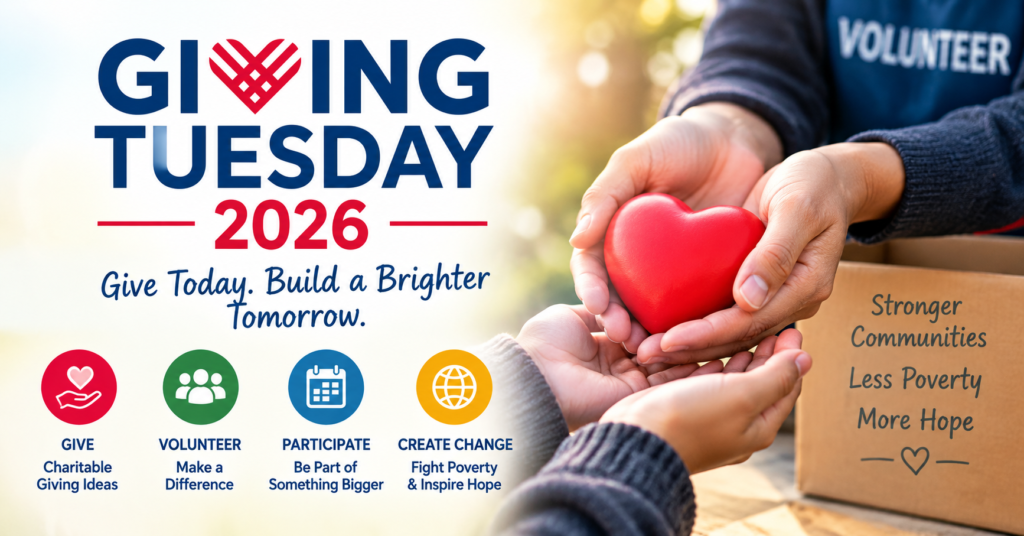
GivingTuesday 2026 Ideas for Different Groups
GivingTuesday 2026 Ideas for Individuals
Start with something manageable. Donate an amount you are comfortable with, volunteer for a couple of hours, share a skill or do something kind for someone you know. Choose a cause that matters to you personally, since that makes it easier to stay involved.
GivingTuesday 2026 Activities for Families
Turn the day into a family kindness challenge where each person picks an act of kindness to complete. You can also donate needed supplies together or volunteer in an age-appropriate activity. Children who see generosity modeled at home are more likely to make it a habit.
GivingTuesday 2026 Ideas for Students and Schools
Organize a supply drive, a student-led service project, a community-awareness campaign or a volunteer activity. Get school approval first, and keep participation voluntary so that no student feels pressured or left out.
GivingTuesday 2026 Ideas for Nonprofits
Set a clear campaign goal and tell an authentic impact story. Explain how donations will be used, make the donation process easy and accessible, and thank supporters promptly. A sincere thank-you is one of the best ways to keep donors engaged.
GivingTuesday 2026 Ideas for Businesses
Offer paid volunteer time where possible, and match employee donations if your business has a confirmed matching program. You can also partner with a local organization for a team service day. Keep participation optional so that employees feel invited, not obliged.
GivingTuesday 2026 Ideas for Online Communities
Share verified fundraisers, highlight volunteer opportunities and encourage helpful actions. Avoid pressuring members to donate. A welcoming tone makes people more likely to take part.
How to Choose a Charity for GivingTuesday 2026
With so many appeals around the holidays, a little research goes a long way:
- Look into the mission. Make sure the organization’s work matches your values.
- Read its latest financial and impact information where it is available.
- Use the official website and donation page, not links from unknown messages.
- Understand how donations are used and whether any platform fees apply.
- Watch for pressure. Be wary of suspicious links and high-pressure requests.
- Consider other ways to give. If a financial gift is not practical, volunteer or donate goods instead.
Your giving decisions should reflect your own interests, budget and research. There is no right amount to give, and nobody should feel pressured to give more than they can afford.
GivingTuesday 2026 Fundraising and Social Media Ideas
If you are raising funds or spreading the word, these habits build trust:
- Set a realistic goal and explain its purpose.
- Use a clear call to action, such as “Donate here” or “Sign up to volunteer.”
- Share real stories only with consent from the people involved.
- Post progress updates and thank supporters publicly.
- Use #GivingTuesday when it is relevant to your post.
- Verify any matching-gift offer before you advertise it.
- Avoid unsupported impact claims, invented urgency or promises of matching that will not happen.
Participation in the movement itself is free, but third-party fundraising and payment platforms may charge fees, so check the details before you launch a campaign.
GivingTuesday 2026 Quotes and Messages
These are original messages for newsletters, announcements and social media.
- “Giving is not measured only by what we give, but by the care and thought behind every act.”
- “When many people give a little, a community gains a lot.”
- “Generosity does not wait for a perfect moment. It begins with a single kind choice.”
- “Every hour volunteered and every item shared helps someone feel they are not alone.”
- “Kindness is the one gift everyone can afford to give.”
Short messages for social media:
- Today I’m giving in the way I can. Join me this #GivingTuesday.
- Time, skills, kindness or a donation: it all counts.
- Small acts, shared widely, change communities.
Messages for charity newsletters and workplaces:
- Thank you to everyone who gives their time, talent and support. You make our work possible.
- This December 1, we invite you to choose one way to help, and to keep helping long after the day is over.
GivingTuesday Facts
- GivingTuesday began in 2012.
- The 2026 observance is Tuesday, December 1.
- It is a global movement centered on generosity.
- Participation can include money, time, goods, skills, advocacy and kindness.
- Individuals and organizations can take part without paying a registration fee.
- People support causes directly through the organizations they choose.
- It always falls on the Tuesday after U.S. Thanksgiving.
Frequently Asked Questions About GivingTuesday 2026
When is GivingTuesday 2026?
GivingTuesday 2026 is Tuesday, December 1.
What is GivingTuesday?
GivingTuesday is a global generosity movement that encourages people to support causes through donations, volunteering, sharing skills, giving goods and acts of kindness.
Why is GivingTuesday celebrated?
It provides a shared opportunity to highlight generosity, support communities and encourage people to contribute to causes they care about.
Do I have to donate money on GivingTuesday?
No. You can volunteer, share your skills, donate goods, advocate for a cause or help someone in your community.
Does GivingTuesday collect donations for all charities?
No. GivingTuesday is a movement, not a central donation-distribution fund. People generally donate directly through the organization or fundraiser they choose.
Is GivingTuesday free to participate in?
Yes. Taking part in the movement is free, although a third-party fundraising or payment platform may charge fees.
How can nonprofits participate in GivingTuesday?
Nonprofits can run their own fundraising campaigns, recruit volunteers, share impact stories, partner with community groups or organize service activities.
Countdown to GivingTuesday 2026
As of October 9, 2026, there are 53 days until GivingTuesday 2026 on Tuesday, December 1. That leaves enough time to pick a cause, plan a school or workplace activity, or sign up for a volunteer shift.
Conclusion
GivingTuesday 2026 on Tuesday, December 1 is a chance to turn good intentions into practical action. Whether you donate, volunteer, share a skill or simply help someone nearby, your effort can make a real difference.
Pick one meaningful, realistic way to take part, and put it on your calendar. Then try to carry that spirit past December 1, because generosity does the most good when it becomes a habit.