
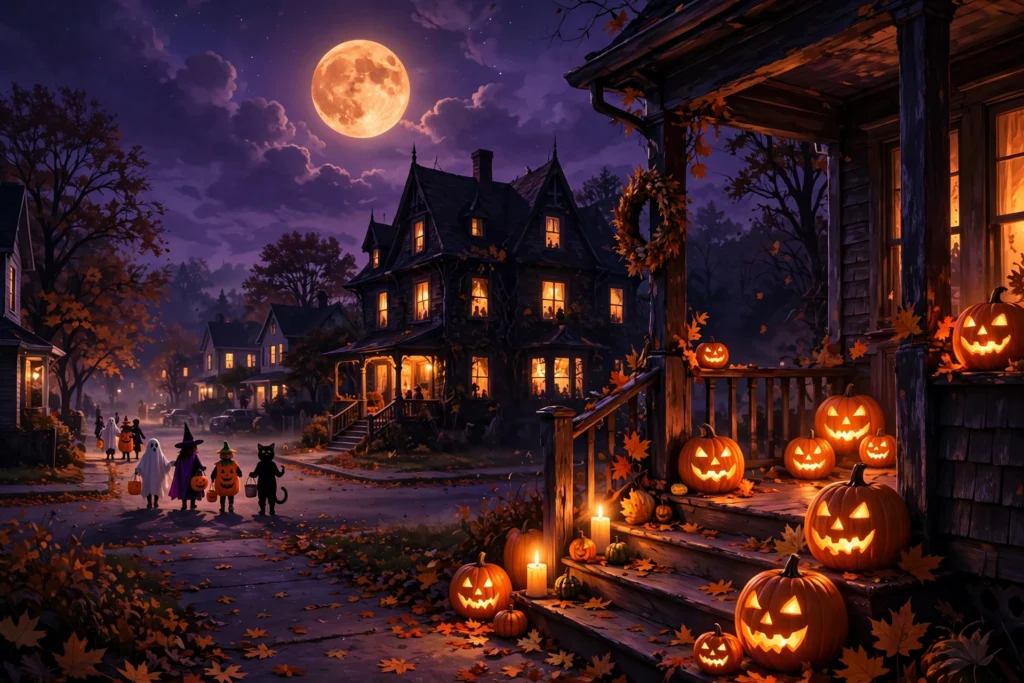
Halloween 2027 falls on Sunday, October 31, 2027 — and because it lands on a Sunday, 2027 gives the holiday a full weekend: the big costume parties happen on Saturday, October 30, and trick-or-treating itself takes place on Sunday evening. It is one of the biggest nights of the American year, when tens of millions of children go door to door in costume, porches glow with jack-o’-lanterns, and whole neighbourhoods turn into haunted streets. This guide has the exact date and a live countdown, the real history from the Celtic festival of Samhain to modern trick-or-treating, the traditions and symbols, what Americans spend, and the safety tips that matter on the night.
🎃 Countdown to Halloween 2027
Loading…
until Sunday, October 31, 2027 at 12:00 AM Eastern Time
When Is Halloween 2027?
Halloween 2027 is on Sunday, October 31, 2027. Halloween is fixed to October 31 every year — it never moves — so the only thing that changes is the weekday. In 2027 that weekday is Sunday, which shapes the whole weekend: most adult parties and haunted-house visits happen on Saturday, October 30, while children go trick-or-treating on the Sunday evening itself.
Because it falls on a Sunday, check your town's plans closer to the date: some communities move official trick-or-treat hours to Saturday evening, and some churches and schools hold their fall festivals on the Saturday. The date itself does not move, but the hours do vary by town.
| Year | Halloween date | Weekday |
|---|---|---|
| 2026 | October 31 | Saturday |
| 2027 | October 31 | Sunday |
| 2028 | October 31 | Tuesday |
| 2029 | October 31 | Wednesday |
| 2030 | October 31 | Thursday |
One practical detail for 2027: daylight saving time does not end until Sunday, November 7, 2027, a full week after Halloween — so Halloween night is still on daylight time, and the clocks do not fall back until the following weekend.
How Many Days Until Halloween 2027?
The live countdown above ticks down to midnight at the start of Sunday, October 31, 2027, Eastern Time — the moment Halloween 2027 begins in the United States. At the time this article was published (November 11, 2026), there were 354 days remaining until Halloween 2027. That is the planning window: costumes and decorations typically appear in stores from late August, and the best costumes and party supplies sell out well before October.
A sky-watcher's note: Halloween night 2027 will not have a full moon. The Hunter's Moon falls on Friday, October 15, 2027, and the new moon follows on October 29 — so on October 31 the moon is only a thin crescent. The spooky full moon in the picture above is artistic licence; the real night sky will be darker, which is all the more reason for flashlights and reflective tape on costumes.
What Is Halloween?
Halloween is the autumn festival celebrated every October 31 in the United States and around the world, when people dress in costume, carve pumpkins into jack-o'-lanterns, decorate their homes, tell ghost stories and go trick-or-treating. Its name is a shortening of All Hallows' Eve — the evening before All Saints' Day on November 1. At its root it is a festival about the boundary between the living and the dead, but in modern America it is mostly a celebration: the second-biggest commercial holiday after Christmas, and the biggest dressing-up night of the year.
The History of Halloween: From Samhain to Trick-or-Treating
Halloween is more than 2,000 years old, and its story runs through three traditions that met and merged: a Celtic festival, a Christian feast, and an American reinvention.
| When | What happened |
|---|---|
| Ancient Celts | The festival of Samhain marked the end of the harvest and the start of winter. The Celts believed that on the night of October 31 the boundary between the world of the living and the world of the dead grew thin, and spirits could cross over. People lit bonfires and wore disguises to confuse or ward off those spirits. |
| Roman influence | As Rome spread across Celtic lands, its own autumn festivals — including Feralia, a day honouring the dead, and a festival for Pomona, goddess of fruit trees — blended into the season. |
| 8th century | Pope Gregory III moved All Saints' Day to November 1, so October 31 became All Hallows' Eve — the night before the feast of all the saints. All Souls' Day followed on November 2, a day to remember the dead. |
| Middle Ages | People went "souling" — going door to door offering prayers for the dead in exchange for small cakes — and "guising" or "mumming", going in disguise from house to house. Both are direct ancestors of trick-or-treating. |
| 1800s | Irish and Scottish immigrants brought Halloween traditions to the United States, including carving faces into turnips to make lanterns. In America the turnip gave way to the pumpkin — bigger, softer and far easier to carve. |
| 1920s–1930s | Trick-or-treating took its modern American form, and the phrase "trick or treat" came into use. The first mass-produced Halloween costumes appeared in the 1930s, and the holiday shifted from a night of pranks into a family celebration. |
| Today | Halloween is one of America's biggest holidays: three in four Americans celebrate it, and the night is shared by children trick-or-treating, adults at costume parties, and whole towns running haunted houses and festivals. |
For the full story, see our Halloween history and origins guide.
Why Do We Celebrate Halloween?
The original reason — marking the turn from harvest to winter and remembering the dead — is still there underneath, in the ghosts, skeletons and graveyards of the decorations. But the reason most Americans celebrate today is simpler: it is the one night of the year when dressing up, being a little bit scared, and sharing sweets with neighbours is the whole point. For children it is the thrill of costumes and candy; for adults it is parties, creativity and nostalgia; for neighbourhoods it is one of the few nights when the whole street is outside together. Halloween survives because it lets everyone play a part for one night.
Halloween Symbols and What They Mean
Every Halloween decoration has a history. Here are the ones you will see most in 2027:
- Jack-o'-lantern: a carved pumpkin with a candle inside. The name comes from the Irish folk tale of Stingy Jack; the lantern was said to ward off evil spirits. Pumpkins replaced turnips in America.
- Black cats: in medieval Europe black cats were linked to witches and bad luck; today they are one of the most recognisable Halloween symbols.
- Ghosts and skeletons: a direct echo of Samhain and All Souls' Day — the dead returning for one night.
- Witches: from the folklore of wise women and healers, later feared and persecuted; the pointed hat and broom are the classic costume.
- Bats and spiders: creatures of the night and of dark, undisturbed places — barns, attics and caves.
- Orange and black: orange stands for the autumn harvest and pumpkins; black stands for darkness and death. Together they are Halloween's colours.
- Candy corn: invented in the 1880s, it became the classic Halloween sweet because its harvest colours matched the season.
How Americans Celebrate Halloween 2027
Halloween in America is not one activity but a whole season of them. The most popular, according to the National Retail Federation's latest survey, are handing out candy (61% of celebrants), dressing in costume (50%), decorating the home or yard (42%), carving pumpkins (42%) and watching scary movies (42%). Here is how the night typically unfolds:
- Trick-or-treating: children in costume go door to door after dark, saying "trick or treat" and collecting candy. It usually starts around dusk — roughly 5:30 to 6:00 PM in most towns — and runs until about 8:00 or 9:00 PM. Hours vary by town, so check your local listings.
- Costumes: witches and ghosts never go out of fashion, but each year brings new favourites from films, TV and games. Costume shops and online stores start selling from late August, and the most popular sizes sell out first.
- Pumpkin carving: families carve jack-o'-lanterns in the week before Halloween and set them on porches with candles or LED lights inside.
- Decorating: yards fill with fake cobwebs, skeletons, tombstones and inflatable ghosts. In 2026 Americans spent $4.3 billion on Halloween decorations alone.
- Parties and haunted houses: adults head to costume parties on the Saturday night — October 30 in 2027 — and haunted houses, corn mazes and pumpkin patches run all through October.
- Scary movies: from family-friendly films to full horror marathons, movie night is one of the most popular ways to spend the evening, at home or at a cinema.
Looking for ideas? Our Halloween celebration ideas guide covers parties, games, food and family activities, and our Halloween decorations guide has DIY ideas for the yard and the porch.
Halloween 2027 by the Numbers
There is no 2027 spending survey yet — the National Retail Federation publishes its annual Halloween survey each September — so the figures below are the latest available, from the 2026 survey, and they show the scale of the holiday:
| Measure | 2026 (latest survey) |
|---|---|
| Total Halloween spending | $13.5 billion |
| Average spending per person | $115.14 |
| Share of Americans celebrating | 74% |
| Spent on costumes | $4.4 billion |
| Spent on decorations | $4.3 billion |
| Handing out candy | 61% of celebrants |
| Dressing in costume | 50% of celebrants |
The survey, conducted by Prosper Insights & Analytics for the National Retail Federation, asked 7,889 consumers about their plans between September 1 and 9, 2026. Spending has risen almost every year since the survey began in 2005; the 2026 total of $13.5 billion edged past the previous record of $13.1 billion in 2025. The 2027 figures will be published in September 2027 — expect them to be similar or higher, and this article will be updated when they land. Source: National Retail Federation.
Trick-or-Treating 2027: Times and Safety
Because Halloween 2027 falls on a Sunday, plan the evening in advance. Most towns run trick-or-treating from around dusk until 8:00 or 9:00 PM, but some communities shift official hours to Saturday, October 30 — check your town or neighbourhood association's notice closer to the date. A few safety basics make the night work for everyone:
- Give children a flashlight or glow stick, and add reflective tape to dark costumes so drivers can see them.
- Stay on sidewalks and cross streets at corners; walk, do not run, between houses.
- Younger children should always go with an adult; older children should stay in groups and stick to well-lit streets they know.
- Check all candy before eating it — throw away anything unwrapped or homemade from a stranger.
- Keep the porch light on if you are handing out sweets, and off if you are not — that is the signal children look for.
- Drive slowly through residential streets on Halloween evening; children are excited, in dark costumes, and not always looking.
- Keep pets indoors — the doorbell, the costumes and the noise stress most animals.
Is Halloween a Federal Holiday?
No — Halloween is not a federal holiday, and it is not a state holiday either. Schools, offices, banks, post offices and shops are open as normal on Friday, October 29 and Monday, November 1, 2027, and on Halloween itself (a Sunday). Many schools hold costume parades or fall parties on the Friday before, and some workplaces allow costumes, but there is no day off. The next federal holiday after Halloween is Veterans Day on Thursday, November 11, 2027 — and the next big celebration is Thanksgiving, on Thursday, November 25, 2027.
Halloween 2026 vs Halloween 2027
Last year Halloween fell on a Saturday, October 31, 2026 — the ideal night, with the whole weekend to celebrate. In 2027 it moves to Sunday, so the parties shift to Saturday, October 30, and the trick-or-treating to Sunday evening. The traditions do not change; only the calendar does. If you want to see how last year looked, our Halloween 2026 guide covers the same ground for the Saturday edition, and our Halloween quotes, messages, wishes and captions work for any year.
Frequently Asked Questions About Halloween 2027
When is Halloween 2027?
Halloween 2027 is on Sunday, October 31, 2027. Halloween is always October 31; only the weekday changes.
How many days until Halloween 2027?
Use the live countdown at the top of this page — it ticks down to midnight at the start of Sunday, October 31, 2027, Eastern Time. At publication (November 11, 2026) there were 354 days remaining.
What day of the week is Halloween 2027?
Sunday. The big party night is Saturday, October 30, 2027, and trick-or-treating takes place on Sunday evening, October 31.
Is there a full moon on Halloween 2027?
No. The full moon in October 2027 is the Hunter's Moon on Friday, October 15, and the new moon falls on October 29 — so Halloween night has only a thin crescent moon.
Is Halloween a federal holiday in 2027?
No. Halloween is not a federal or state holiday. Schools, banks, post offices and businesses are open as normal.
What time is trick-or-treating in 2027?
Most towns run it from around dusk (roughly 5:30–6:00 PM) until about 8:00–9:00 PM on Sunday, October 31. Some towns move official hours to Saturday, October 30 — check your local listings.
When do Halloween costumes go on sale for 2027?
Costumes and decorations typically appear in stores from late August 2027, with the widest choice in September. Popular sizes and characters sell out first, so shopping in September is the safest bet. No specific 2027 offers or prices have been announced as of November 2026.
Why do we wear costumes on Halloween?
The custom goes back to Samhain, when people wore disguises to confuse or ward off spirits crossing into the world of the living. In the Middle Ages people went "guising" from house to house in costume, and the tradition carried into American trick-or-treating.
Sources and References
- Wikipedia — Halloween (history, Samhain, All Hallows' Eve, trick-or-treating)
- Encyclopaedia Britannica — Halloween (origins and traditions)
- National Retail Federation — 2026 Halloween consumer survey (spending figures, via Prosper Insights & Analytics, September 2026)
- MemorialDay2026.com — home, for the full calendar of American holidays and celebrations