
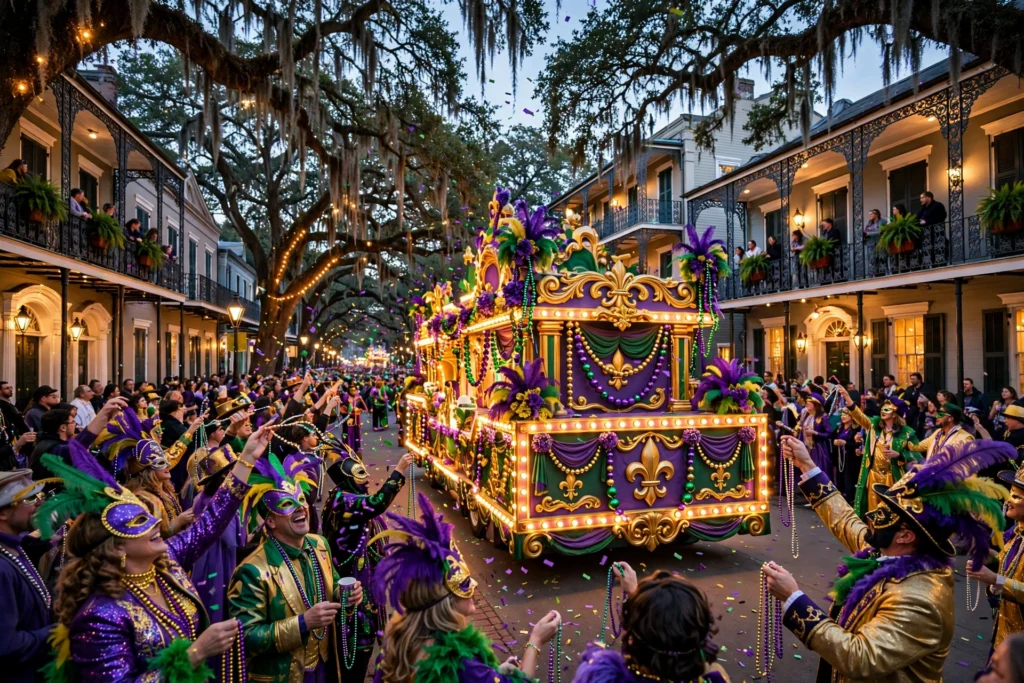
Mardi Gras 2027 falls on Tuesday, February 9, 2027. Known as Fat Tuesday, it is the final day of the Carnival season — the day before Ash Wednesday (February 10, 2027) and the last chance to feast before Lent begins. The season opens on Twelfth Night, January 6, 2027, giving 2027 one of the shortest Carnival seasons in recent memory at just 34 days.
New Orleans is the centre of it all, with 46 parades listed for 2027, but Mardi Gras is celebrated across Louisiana and the Gulf Coast — most famously in Mobile, Alabama, where the first American Mardi Gras was held in 1703. This guide covers the 2027 date and why it moves, the New Orleans parade schedule, the history behind the krewes, the colours and the king cake, and how to celebrate whether you are on St. Charles Avenue or at home.
Mardi Gras 2027 at a glance
| Detail | 2027 |
|---|---|
| Mardi Gras Day (Fat Tuesday) | Tuesday, February 9, 2027 |
| Carnival season begins (Twelfth Night) | Wednesday, January 6, 2027 |
| Lundi Gras | Monday, February 8, 2027 |
| Ash Wednesday | Wednesday, February 10, 2027 |
| Easter Sunday | Sunday, March 28, 2027 |
| Main celebration | New Orleans, Louisiana (also Mobile, AL and across the Gulf Coast) |
| Official colours | Purple (justice), green (faith), gold (power) |
When is Mardi Gras 2027 — and why does the date move?
Mardi Gras is always the Tuesday before Ash Wednesday. Ash Wednesday falls 46 days before Easter Sunday, so Fat Tuesday is 47 days before Easter. Because Easter is a moveable feast — the first Sunday after the first full moon on or after the spring equinox — Mardi Gras can fall on any Tuesday from February 3 to March 9. In 2027 Easter lands early, on March 28, so Mardi Gras lands early too, on February 9.
That early date compresses the whole season. From Twelfth Night on January 6 to Fat Tuesday on February 9 is only 34 days, one of the shortest Carnival seasons in living memory. The big parades stack tightly into the first week of February, with parades every night from February 3 to February 9.
Future Mardi Gras dates, so you can plan ahead:
| Year | Mardi Gras Day |
|---|---|
| 2027 | Tuesday, February 9 |
| 2028 | Tuesday, February 29 |
| 2029 | Tuesday, February 13 |
| 2030 | Tuesday, March 5 |
Mardi Gras 2027 parade schedule in New Orleans
New Orleans & Company lists 46 parades for 2027, running from January 6 to February 9. Important: as of November 6, 2026, the 2027 parade dates and start times are still provisional — the city and the krewes confirm final times closer to the season. Treat the times below as expected, based on each krewe’s traditional day, and confirm at neworleans.com or mardigrasneworleans.com before you travel.
The season opens on Twelfth Night, Wednesday, January 6, with the Phunny Phorty Phellows streetcar parade Uptown and the Krewe of Joan of Arc in the French Quarter. The French Quarter walking parades follow in late January — the Intergalactic Krewe of Chewbacchus on Saturday, January 16, and Krewe du Vieux on Saturday, January 23.
The closing run is where the famous krewes roll:
- Thursday, February 4 — Krewe of Muses, the all-female krewe famous for its hand-decorated shoe throws, rolls Uptown in the evening.
- Friday, February 5 — Krewe of Hermes, Krewe d’Etat and Krewe of Morpheus roll Uptown.
- Saturday, February 6 — Krewe of Iris and Krewe of Tucks during the day, then Krewe of Endymion, the largest parade, in the evening through Mid-City. Endymion’s own site lists a 4:00 p.m. start.
- Sunday, February 7 — Krewe of Okeanos, Krewe of Mid-City and Krewe of Thoth during the day, then Krewe of Bacchus in the evening.
- Monday, February 8 (Lundi Gras) — Krewe of Proteus in the late afternoon, followed by the Krewe of Orpheus.
- Tuesday, February 9 (Mardi Gras Day) — Zulu Social Aid & Pleasure Club rolls at about 8:00 a.m., followed by the Krewe of Rex, the symbolic King of Carnival, at about 10:30 a.m. The Elks-Orleans and Crescent City parades follow.
Most Uptown parades follow the classic route: starting near Napoleon Avenue and Tchoupitoulas Street, turning onto St. Charles Avenue toward downtown, then onto Canal Street. If you can only be in New Orleans for one stretch, make it Saturday, February 6 through Tuesday, February 9 — Muses, Endymion, Bacchus, Orpheus, Zulu and Rex all roll in those four days.
What is Mardi Gras?
Mardi Gras is French for “Fat Tuesday” — the last day before Lent, when Christians traditionally used up rich foods like meat, eggs, milk and cheese before the fasting season that begins on Ash Wednesday and runs to Easter. In medieval Europe it was a day of feasting and revelry before the solemn weeks of Lent, and French settlers carried the tradition to Louisiana.
The first American Mardi Gras was not in New Orleans at all. In 1699, French-Canadian explorer Jean-Baptiste Le Moyne, Sieur de Bienville, landed near present-day Mobile, Alabama on the eve of the festival and named the spot Pointe du Mardi Gras. Mobile celebrated the first Mardi Gras in America in 1703, and the tradition moved to New Orleans as the city grew into the region’s great port.
How New Orleans made it famous: krewes, Rex and the colours
By the 1830s New Orleans held street processions of masked riders and carriages, but by the 1850s the celebrations had grown rowdy enough that city officials threatened to ban them. In late 1856 the Mistick Krewe of Comus was founded, and in 1857 it staged the first organised night parade — torch-lit floats, marching bands and masked riders — saving the celebration and inventing the krewe system. Krewes are the private clubs that organise the parades, balls and throws to this day; there are between 50 and 80 of them in and around New Orleans.
The look of Mardi Gras was set in 1872, when Russian Grand Duke Alexis Romanov visited New Orleans during Carnival. The city created a “King of Carnival” — Rex, Latin for king — to greet him, and Rex’s first parade established purple, green and gold as the official colours. In 1892 the Rex parade’s theme, “Symbolism of Colors”, fixed their meanings: purple for justice, green for faith, gold for power.
The traditions that make the day
King cake
The king cake is a ring-shaped, cinnamon-flavoured pastry decorated with purple, green and gold sugar. Its roots run back through French galette des rois to Epiphany on January 6, when the Three Kings visited the infant Jesus — which is why king cake season runs from Twelfth Night to Fat Tuesday. Hidden inside each cake is a small plastic baby: whoever finds it in their slice is said to have good luck, and is expected to provide the next king cake.
Throws: beads, doubloons and shoes
Float riders toss “throws” to the crowds — strands of beads, doubloon coins, cups and stuffed animals. The bead tradition dates to the late 1870s, when Rex began tossing inexpensive necklaces to the crowd. Some throws are prized: the Krewe of Muses’ hand-decorated high-heeled shoes are among the most sought-after catches of the season.
Masks and costumes
Masks are one of the oldest parts of the celebration. They let revelers hide social rank and class for a day — and in New Orleans, masks are legally required for float riders, a rule that dates back to the early parades. Costumes range from elaborate feathered gowns to homemade outfits in the three official colours.
Flambeaux
Flambeaux — carriers of flaming torches — date back to the first Comus parade in 1857, when they lit the way for the night procession. They still walk ahead of the floats in the evening parades, and it is customary to tip them.
Lundi Gras
Lundi Gras, the Monday before Mardi Gras, has its own celebrations, including the arrival of Rex by boat on the Mississippi and the Proteus and Orpheus parades in the evening. It is the last full day of Carnival before Fat Tuesday itself.
Is Mardi Gras a holiday? What is open and closed?
Mardi Gras is a legal state holiday in Louisiana, so state offices, courts and public schools in the New Orleans area close on Fat Tuesday, and many local businesses shut or run reduced hours. It is not a federal holiday, so federal offices and most businesses elsewhere in the United States stay open. If you are visiting New Orleans on February 9, 2027, expect street closures along the parade routes, crowded public transport and higher hotel prices — book early, and check the city’s official parade tracker in the week before you travel.
Celebrating Mardi Gras at home
You do not need to be in Louisiana to mark the day. A home celebration can be simple:
- Bake or buy a king cake — many bakeries ship them nationwide during Carnival season, and the baby goes in after baking if you make your own.
- Cook Louisiana food — gumbo, jambalaya, red beans and rice and beignets are the classic Fat Tuesday table.
- Wear the colours — purple, green and gold decorations, beads and masks turn any room into a parade.
- Play the music — New Orleans jazz and brass bands set the mood, and the season’s unofficial anthem is the Mardi Gras Indians’ chant “Iko Iko”.
- Watch the parades — local New Orleans stations and streaming coverage carry the Zulu and Rex parades live on Fat Tuesday morning.
Mardi Gras 2027 and the days around it
Mardi Gras 2027 sits in a packed February. Groundhog Day 2027 falls a week earlier, on Tuesday, February 2, and Lunar New Year 2027 — the Year of the Fire Goat — is celebrated on Saturday, February 6, right in the middle of parade week. The very next Sunday, February 14, is both Valentine’s Day 2027 and Super Bowl LXI at SoFi Stadium, and the Monday after is Presidents’ Day 2027. If you are planning a February trip, the whole stretch from February 6 to February 15 is one long celebration.
No 2027 Mardi Gras deals or offers are listed here: none were verified from official sources at the time of writing, November 6, 2026. Parade dates and times for 2027 are provisional until confirmed by the krewes and the city — check neworleans.com before travelling.
Frequently asked questions
When is Mardi Gras 2027?
Tuesday, February 9, 2027. The Carnival season runs from Twelfth Night, Wednesday, January 6, to Fat Tuesday, February 9.
Why is Mardi Gras so early in 2027?
Mardi Gras is always the Tuesday before Ash Wednesday, 47 days before Easter. Easter falls early in 2027, on Sunday, March 28, so the whole Carnival season shifts earlier and is unusually short at 34 days.
What are the Mardi Gras colours and what do they mean?
Purple, green and gold — chosen by the Krewe of Rex in 1872 and given their meanings in 1892: purple stands for justice, green for faith, and gold for power.
What is a krewe?
A krewe is a private club that organises a Mardi Gras parade, ball and other Carnival events. The first, the Mistick Krewe of Comus, staged the first organised parade in 1857. The best-known krewes today include Rex, Zulu, Endymion, Bacchus, Muses and Orpheus.
What is in a king cake?
A ring-shaped cinnamon pastry topped with purple, green and gold sugar, with a small plastic baby hidden inside. Whoever finds the baby has good luck — and buys the next cake.
Is Mardi Gras a federal holiday?
No. It is a state holiday in Louisiana, where government offices and schools close, but it is a normal working day in the rest of the United States.
Sources: New Orleans & Company — Ultimate Guide to Mardi Gras, New Orleans & Company — Mardi Gras 2027 Parade Schedule, Reader’s Digest — Mardi Gras Traditions, History & Origins. Dates verified November 6, 2026.