
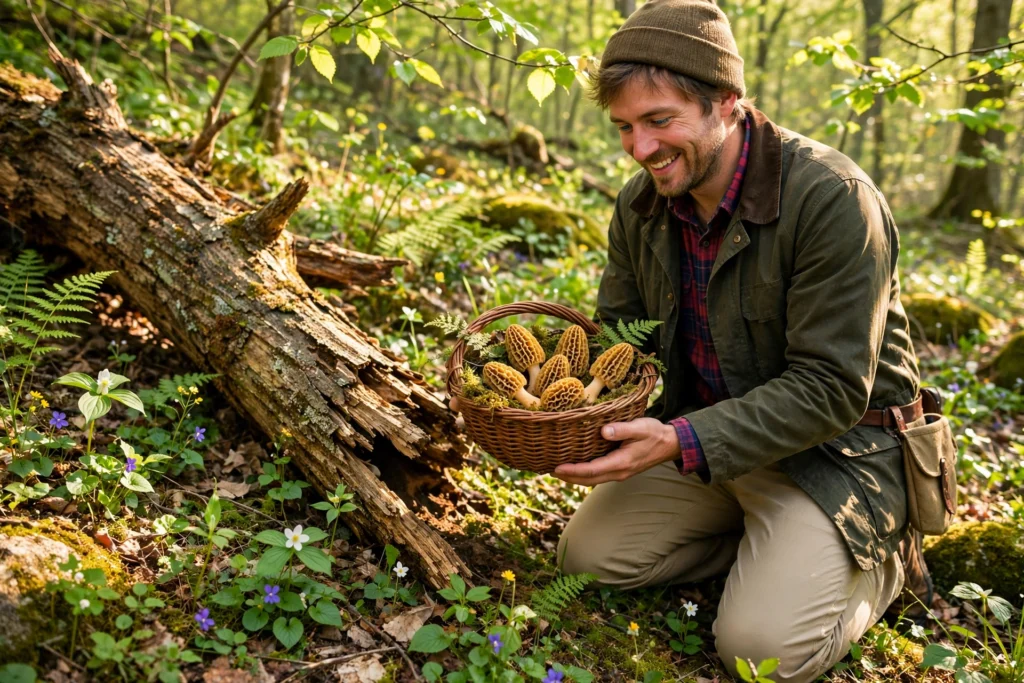
National Mushroom Hunting Day 2027 is on Monday, May 17, 2027. It is the spring day that sends thousands of Americans into the woods with a basket, a field guide and a sharp eye, looking for one of the most prized wild foods on the continent: the morel mushroom. This guide has the exact date, a live countdown, the story of how the day began, when and where morels actually grow, how to tell a true morel from a poisonous false morel, the safety rules every beginner must know, and practical ways to celebrate whether you forage, cook or simply eat mushrooms.
Countdown to National Mushroom Hunting Day 2027
Loading…
until Monday, May 17, 2027 at 12:00 AM Eastern Time
When Is National Mushroom Hunting Day 2027?
National Mushroom Hunting Day 2027 falls on Monday, May 17, 2027. The date is fixed on May 17 every year, so the weekday changes from year to year. In 2026 it was a Sunday, in 2028 it will be a Wednesday, in 2029 a Thursday, in 2030 a Friday, and in 2031 a Saturday. It is not a federal holiday, so schools, offices and shops stay open. It is an unofficial food and nature observance, and its timing is no accident: mid-May sits right in the middle of morel season across much of the northern United States.
| Year | Date | Day of the week |
|---|---|---|
| 2026 | May 17 | Sunday |
| 2027 | May 17 | Monday |
| 2028 | May 17 | Wednesday |
| 2029 | May 17 | Thursday |
| 2030 | May 17 | Friday |
| 2031 | May 17 | Saturday |
How Many Days Until National Mushroom Hunting Day 2027?
The live countdown above ticks down to midnight at the start of Monday, May 17, 2027, Eastern Time. At the time this article was published (November 22, 2026), there were 176 days remaining until National Mushroom Hunting Day 2027. That is just over 25 weeks, which puts the day in the middle of May, one week after Mother's Day 2027 and two weeks before Memorial Day 2027 weekend. May 17 is a busy date on the calendar: it is also National Walnut Day 2027, National Graduation Tassel Day 2027, National Cherry Cobbler Day 2027, National Pack Rat Day 2027 and National Idaho Day 2027.
What Is National Mushroom Hunting Day?
National Mushroom Hunting Day is a day for foragers, cooks and anyone who loves the outdoors. It celebrates the old tradition of hunting for wild mushrooms, the fungi that grow in forests and fields and cannot be planted like a garden crop. The day marks the beginning of the mushroom hunting season, when spring morels push through the warming soil and the woods fill with people carrying baskets and mesh bags.
The day was created in 2014 by Jace Shoemaker-Galloway, a freelance writer and mushroom enthusiast known as the "Queen of Holidays". She has created dozens of food and nature observances, and this one was her way of shining a spotlight on a rewarding but underappreciated outdoor tradition. It is an unofficial holiday, recognised by national-day calendars rather than by Congress, but it has been listed on May 17 every year since 2014.
Why May 17 Is Morel Season
The star of National Mushroom Hunting Day is the morel. Morels are cone-shaped mushrooms with a honeycomb cap, a rich, meaty texture and an earthy flavour that chefs prize. They are also famously hard to find and almost impossible to farm. Attempts to grow them commercially have met with mixed success because their lifecycle depends on the seasons, humidity, temperature and a symbiotic relationship with their environment. If you want morels on your table, you or someone you know has to find them in the wild, or pay for them: fresh morels often sell for upwards of $25 a pound at local stores and markets, and a freshly foraged shipment was reported at $79 a pound at a Dayton market in 2022. Dried morels can cost $25 or more an ounce.
Morel season runs from mid-March through as late as June, depending on local conditions and climate. It starts in the south and moves north as temperatures climb. The rule of thumb is a good week of daytime temperatures in the 60s and nighttime temperatures in the 40s or higher, which warms the soil enough for the mushrooms to push through. Most mycologists put the trigger at a ground temperature of about 50 degrees Fahrenheit, four to six inches below the surface. In the Midwest that usually happens in mid- to late April, and morels then appear for a two- to three-week window. A single morel emerges, grows and dries within about four to six days, and they can seem to pop overnight when conditions are right, so timing matters as much as location.
Where to Look for Morels
Morels like well-drained, loamy soil, so creek bottoms and forest floors close to riverbeds are good places to start. They grow around elm, ash, aspen, poplar, oak and old apple trees, and dead or dying trees are prime spots because of the nutrients and moisture the decaying wood returns to the soil. Ground that has been disturbed, logged, burned or flooded can be very productive too. Early in the season, check south-facing slopes first, because they warm up fastest; later in the season, morels retreat to cooler, north-facing slopes and deeper into the woods.
Experienced hunters also watch the plants. In Nebraska, morels are often found among jack-in-the-pulpits, may-apples, ferns and phlox, which prefer the same soil, moisture, slope and sunlight. Others time the season to the appearance of dandelions, lilacs, cherry blossoms, violets or redbuds. And one piece of advice appears in every guide: when you find one morel, slow down and search the area carefully, because they usually grow in groups.
True Morel vs False Morel: How to Tell Them Apart
This is the most important section of this guide. True morels are safe to eat when cooked. False morels look very similar and are poisonous. Never eat a wild mushroom you cannot identify with complete confidence, and if you are new to foraging, go with someone experienced or take a field guide and study it before you go.
| Feature | True morel | False morel |
|---|---|---|
| Cap | Pitted, honeycomb pattern, like a sponge | Wrinkled, brain-like folds |
| Cap and stem | Cap edge is joined to the stem | Cap hangs free like a parasol, joined only at the top |
| Inside | Completely hollow, stem and cap | Solid or chambered, not hollow |
| Colour | Black, grey or whitish-yellow | Often reddish-brown |
| Safe to eat | Yes, when cooked thoroughly | No, poisonous |
Cut the mushroom in half lengthwise to check. A true morel is hollow all the way through. A false morel is not. That single test, plus the pitted cap and the cap joined to the stem, is how most hunters confirm their find. When in doubt, throw it out: no meal is worth the risk.
Mushroom Safety: The Numbers Every Forager Should Know
Wild mushroom hunting is safe when it is done carefully, but the risks are real and the statistics are worth knowing. A peer-reviewed study of 18 years of US National Poison Data System records found 133,700 reported mushroom exposure cases between 1999 and 2016, an average of about 7,428 cases a year reported to US poison control centres. About 86 percent of exposures caused no harm or only minor symptoms, and 62 percent involved children under six. The deaths were few, about 2.9 a year, but almost all of them came from one group of mushrooms: the cyclopeptide producers, above all the death cap (Amanita phalloides), which is responsible for more than 90 percent of mushroom-related fatalities.
The death cap is dangerous precisely because it does not announce itself. Its amatoxin poison has a delayed onset of roughly 6 to 24 hours, during which a person can feel well or have only mild symptoms, and then severe stomach illness follows, with liver and kidney failure possible in the days after. Cooking, drying or boiling does not remove amatoxin. That is why the first rule of foraging is absolute: never eat a wild mushroom unless you are 100 percent sure what it is, and keep a whole uncooked specimen of anything you eat so it can be identified if someone falls ill.
Other safety rules to follow on every hunt:
- Go with an expert the first time. A local mycological club is the best classroom. The North American Mycological Association (NAMA), launched on February 20, 1967, has more than 90 affiliated clubs across the United States, Canada and Mexico, and has run an annual foray since 1961.
- Get permission. Always ask the landowner before hunting on private land. Many state parks and nature preserves prohibit picking, so check the rules for the land you are on and respect fences and boundaries.
- Carry a mesh bag. It keeps mushrooms fresh and lets spores fall back to the forest floor as you walk, which helps future harvests.
- Cut, do not pull. Cut the stem at ground level so the underground mycelium stays intact and can fruit again.
- Cook morels thoroughly. Raw morels can cause stomach upset, so never eat them raw. Sauté, fry or add them to pasta only after cooking them through.
- Keep your spots secret. Morel hunters guard their patches closely, and for good reason: a productive spot can stay productive for years.
10 Ways to Celebrate National Mushroom Hunting Day 2027
- Go on a morel hunt. Head out on the morning of May 17, or the weekend before, with a basket, a mesh bag, a field guide and a friend who knows the woods.
- Join a guided foray. Many mushroom clubs run spring forays in May. It is the safest way for a beginner to learn identification in the field.
- Cook what you find. The classic is morels sautéed in butter with a little garlic and salt. They are also superb in pasta, risotto, omelettes and cream sauces.
- Try a morel recipe you have never made. Stuffed morels, morel and asparagus pasta, or morels fried in a light batter are all worth trying.
- Visit a farmers market. If you cannot forage, buy fresh morels from a trusted vendor while they are in season and ask the seller how they were identified.
- Learn one new mushroom. Morels are the star, but spring also brings oyster mushrooms, dryad's saddle and, in the south, chanterelles later in the year. Learn to identify one more edible species properly.
- Plant a mushroom log. Shiitake and oyster mushrooms can be grown at home on hardwood logs, and a log inoculated in spring can fruit for years.
- Go to a morel festival. Boyne City, Michigan, has hosted its National Morel Mushroom Festival since the 1960s, with the 60th edition held in May 2026. It has guided hunts, a competitive hunt, a Taste of Morels dinner and a craft beer block party.
- Photograph the hunt. Morels blend into the forest floor, so spotting one is a small triumph. Photograph your finds before you pick them.
- Share the meal, not the spot. Invite friends to dinner with your harvest, and keep your best patch to yourself, as every morel hunter does.
A Short History of Mushroom Hunting
People have hunted mushrooms for thousands of years, and the hobby has a longer history than the holiday. Shiitake mushrooms were first cultivated in China in the 12th century, and button mushrooms were first cultivated in France in the 1700s. In North America, organised mushroom hunting took shape in the 20th century: NAMA began as the People-to-People Committee on Fungi in November 1959 and was formally launched in 1967, and its annual forays have brought amateurs and professional mycologists together since 1961. The Boyne City festival, born from a bar-room argument about who had found the biggest morel, turned a local pastime into a national event. National Mushroom Hunting Day, created in 2014, is the newest chapter: a single spring day that reminds people the woods are full of food, if you know where to look and how to look safely.
Of the roughly 100,000 mushroom species known worldwide, fewer than 0.1 percent are known to be toxic, according to toxicology literature. The problem is not that most mushrooms are dangerous, but that the dangerous ones can look like the delicious ones. That is the whole point of the day: to celebrate the hunt, and to respect the knowledge it takes to do it well.
Also on May 17, 2027
National Mushroom Hunting Day shares its date with five other observances already covered on this site. If you are planning your May 17, you can also mark National Walnut Day 2027, National Graduation Tassel Day 2027, National Cherry Cobbler Day 2027, National Pack Rat Day 2027 and National Idaho Day 2027. May 17, 2027, is the last of the six May 17 observances on this site, which completes the date. The next uncovered dates fall on May 18, 2027.
Frequently Asked Questions
When is National Mushroom Hunting Day 2027?
Monday, May 17, 2027. The date is fixed on May 17 every year.
How many days until National Mushroom Hunting Day 2027?
At publication (November 22, 2026), 176 days remained. Use the live countdown at the top of this page for the exact time left.
Who created National Mushroom Hunting Day?
Jace Shoemaker-Galloway, a freelance writer and mushroom enthusiast known as the "Queen of Holidays", created the day in 2014 to mark the beginning of mushroom hunting season.
What mushrooms do people hunt on this day?
Morels above all, because mid-May is peak morel season across much of the northern United States. Spring foragers also look for oyster mushrooms and dryad's saddle, depending on the region.
How do I know if a morel is a true morel?
A true morel has a pitted, honeycomb cap whose edge is joined to the stem, and it is completely hollow inside when cut in half lengthwise. A false morel has a wrinkled, brain-like cap that hangs free like a parasol and a solid or chambered stem. When in doubt, throw it out.
Can I eat morels raw?
No. Raw morels can cause stomach upset. Always cook morels thoroughly before eating them.
Is mushroom hunting legal?
It depends on the land. Mushroom hunting is allowed on many public lands, but many state parks and nature preserves prohibit picking, and private land always requires the landowner's permission. Check the rules for the land you plan to visit before you go.
How much do morels cost?
Fresh morels often sell for upwards of $25 a pound at local stores and markets, and prices can be much higher in a short season. Dried morels can cost $25 or more an ounce. That is one reason foragers guard their patches.
What should I do if someone eats a poisonous mushroom?
Call Poison Control immediately at 1-800-222-1222 in the United States, or call 911 if the person is seriously ill. Keep a whole uncooked specimen of the mushroom so it can be identified. Do not wait for symptoms, because amatoxin poisoning can take 6 to 24 hours to appear.
Where can I learn more about mushroom identification?
The North American Mycological Association lists more than 90 affiliated clubs, and local clubs run spring forays where beginners can learn in the field. Good field guides include National Today's National Mushroom Hunting Day page, the Nebraska Game and Parks Commission morel guide and Visit Escanaba's morel hunting tips.
No 2027 deals or prices are listed in this article because none were verified from official sources at the time of writing (November 22, 2026). Morel prices quoted are dated market observations, not current offers.