
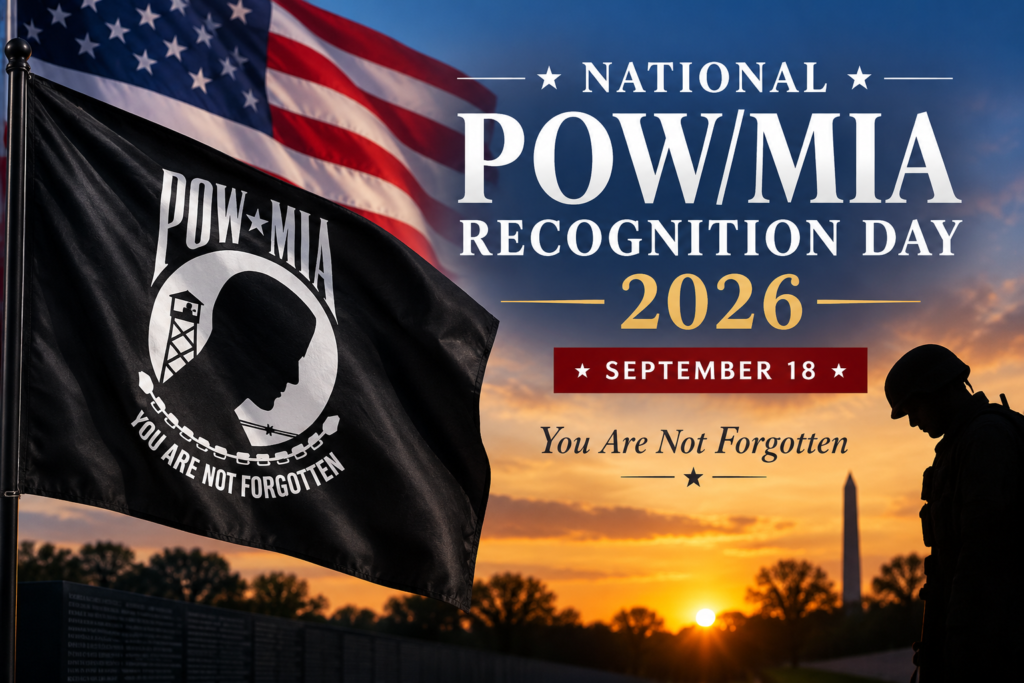
National POW/MIA Recognition Day 2026 falls on Friday, September 18, 2026. Each year, this solemn observance honors Americans who were once held as prisoners of war and those who remain missing and unaccounted for, spanning every conflict in U.S. military history. The day is marked by ceremonies, “flag displays,” and quiet moments of remembrance across the country, much like the reflection many Americans practice around Memorial Day and Veterans Day.
At its center is the POW/MIA flag, a black-and-white symbol that has come to represent a national promise: that those who served and those still missing will never be forgotten.
Quick Answer: National POW/MIA Recognition Day 2026 is Friday, September 18. It falls on the third Friday of September and honors Americans who were prisoners of war and those still missing or unaccounted for.
When Is National POW/MIA Recognition Day 2026?
| Fact | Details |
|---|---|
| Date | Friday, September 18, 2026 |
| Day | Third Friday of September |
| Observance | National POW/MIA Recognition Day 2026 |
| Purpose | Honor POWs and those missing or unaccounted for |
| Symbol | POW/MIA flag |
| Motto | “You Are Not Forgotten” |
| Established | 1979 |
| Established By | President Jimmy Carter |
The observance is deliberately set on a recurring calendar pattern rather than a fixed date, which is why the exact day shifts slightly from year to year.
What Is National POW/MIA Recognition Day?
POW stands for Prisoner of War, and MIA stands for Missing in Action. Together, these terms describe two of the most painful outcomes of military service: capture by an enemy force, and disappearance without confirmation of death or survival.
The observance doesn’t focus on a single war. Instead, it recognizes every American service member who was ever taken prisoner or who remains unaccounted for, from World War II through more recent conflicts. This is an important distinction, since many people mistakenly associate the day only with the Vietnam War, when in fact the modern observance covers Americans across generations of service.
History of National POW/MIA Recognition Day
How the Observance Began
The push for a national day of recognition grew largely out of the experiences of Vietnam-era families. Wives, parents, and children of missing and captured service members organized to demand more information and greater national attention to their loved ones’ fates. Their advocacy laid the groundwork for a formal national observance.
In 1979, following congressional action, President Jimmy Carter established National POW/MIA Recognition Day through a presidential proclamation. Since then, it has been observed annually on the third Friday of September, and every president since has continued to issue a proclamation marking the day.
Why the Day Was Created
The observance exists to:
- Honor those who endured captivity as prisoners of war
- Remember those who never returned home
- Support families who continue to wait for answers
- Reaffirm the nation’s commitment to accounting for missing service members
POW/MIA Flag History
The POW/MIA flag is one of the most recognizable symbols of military remembrance in the United States, and its origin story is closely tied to the families who pushed for national recognition.
Who Created the POW/MIA Flag?
In the early 1970s, a woman named Mrs. Michael Hoff, whose husband was listed as missing in action, recognized the need for a visual symbol that could represent POWs and MIAs to the public. She reached out to Annin & Company, a longtime American flag manufacturer.
Designer Newt Heisley, working with Norman Rivkees, created the flag’s now-familiar design. In January 1972, the National League of POW/MIA Families formally approved the design, and flags began to be distributed nationwide shortly after.
What Does the POW/MIA Flag Represent?
The flag’s design is intentionally stark and somber. It features:
- A black-and-white color scheme
- A silhouette representing a prisoner of war
- A guard tower and barbed wire in the background
- The letters “POW” and “MIA”
- The phrase “You Are Not Forgotten”
Every element was chosen to communicate captivity, vigilance, and an enduring national promise rather than to glorify conflict.
What Does “You Are Not Forgotten” Mean?
The phrase printed on the POW/MIA flag is more than a slogan. It represents an ongoing national commitment to:
- Remember prisoners of war
- Remember those who never came home
- Support the families still waiting for answers
- Continue efforts to locate, identify, and return missing Americans
Featured Answer: “You Are Not Forgotten” means that American POWs, MIAs, and their families remain remembered, and that the nation continues its efforts to account for those who have not returned home.
How to Display the POW/MIA Flag
Can You Fly the POW/MIA Flag?
Yes. Displaying the POW/MIA flag is one of the most visible and widely practiced ways individuals, businesses, and government buildings show support for the observance.
Where Is It Officially Displayed?
Federal law requires the POW/MIA flag to be flown at designated federal locations on several specific days each year, including:
- Armed Forces Day
- Memorial Day
- Flag Day
- Independence Day
- National POW/MIA Recognition Day
- Veterans Day
If you’re planning ahead for these dates, our Memorial Day 2026 guide and Veterans Day 2026 page both include flag-etiquette details worth reviewing alongside this one.
How Should It Be Displayed With the U.S. Flag?
When flown on a single flagpole, the POW/MIA flag should be positioned directly below the U.S. flag and should never be larger than it. When flown on separate poles, the U.S. flag always takes precedence in position and prominence.
Flag display customs can vary slightly depending on the setting and applicable law, so it’s worth confirming specifics with official U.S. flag guidance for your particular situation. For a broader overview of flag etiquette traditions, Wikipedia’s entry on the Flag of the United States offers useful general background.
Why National POW/MIA Recognition Day 2026 Matters
Remembering Former POWs
The day honors the courage and endurance of those who survived captivity, often under extremely difficult conditions, and returned home forever changed by the experience.
Remembering Those Still Missing
Thousands of cases remain unresolved. The observance keeps these cases in the public consciousness rather than letting them fade with time.
Supporting Military Families
For families of the missing, uncertainty can last decades. National recognition reinforces that their loved ones, and their wait for answers, matter to the country.
Preserving Historical Memory
The day also serves an educational purpose, helping younger generations understand the sacrifices tied to military captivity and disappearance, similar to how Memorial Day traditions preserve the memory of those who died in service.
What Does the Defense POW/MIA Accounting Agency Do?
The Defense POW/MIA Accounting Agency (DPAA) is the federal agency responsible for accounting for missing U.S. military personnel. Its work includes:
- Investigating cases of missing service members
- Recovering remains from former conflict sites
- Identifying recovered remains through forensic and scientific methods
- Repatriating identified remains to families
- Communicating directly with families throughout the process
- Conducting historical and archival research to locate leads
The DPAA’s ongoing mission reflects the scale of the effort: tens of thousands of Americans remain missing from World War II, the Korean War, the Vietnam War, and the Cold War era.
How to Observe National POW/MIA Recognition Day 2026
Attend a Recognition Ceremony
Many VA medical centers, military installations, and veterans’ organizations host ceremonies on or around September 18. Checking local listings in advance is the best way to find an event near you.
Display the POW/MIA Flag
Whether at a business, government building, or private residence, flying the flag appropriately is one of the simplest and most visible ways to participate.
Learn a POW/MIA Story
Researching an individual service member’s story, or a family’s decades-long search for answers, helps personalize the observance beyond its historical facts.
Visit a Memorial
Local veterans’ memorials, cemeteries, and military museums often have exhibits or sections dedicated to POWs and MIAs.
Share a Respectful Message
Social media can be a meaningful way to raise awareness, provided the tone stays respectful rather than promotional.
National POW/MIA Recognition Day 2026 Quotes and Messages
Because this is a solemn military observance, it’s best to rely on original, respectful messages rather than misattributed quotes. A few examples suitable for cards or social posts:
- “Remember those who served, and never forget those who never came home.”
- “Honor their service. Remember their sacrifice.”
- “Their names, stories, and sacrifices deserve to be remembered.”
Social Media Captions for National POW/MIA Recognition Day 2026
Consider pairing a respectful caption with a photo of the POW/MIA flag or a local ceremony. Suggested hashtags include:
#POWMIA #POWMIADay #POWMIARecognitionDay2026 #YouAreNotForgotten #NeverForgotten #MilitaryRemembrance #Veterans
Keep the tone reflective rather than casual, since this observance centers on ongoing loss and uncertainty for many families.
Quick Facts Recap
| Question | Answer |
|---|---|
| When is National POW/MIA Recognition Day 2026? | September 18, 2026 |
| What day of the week? | Friday |
| When is it observed each year? | Third Friday of September |
| What does POW mean? | Prisoner of War |
| What does MIA mean? | Missing in Action |
| When was the observance established? | 1979 |
| Who established it? | President Jimmy Carter |
| What is the POW/MIA motto? | “You Are Not Forgotten” |
| When was the flag approved for distribution? | January 1972 |
| Who helped design the flag? | Newt Heisley and Norman Rivkees, Annin & Company |
Frequently Asked Questions
When is National POW/MIA Recognition Day 2026? National POW/MIA Recognition Day 2026 is Friday, September 18. It’s observed annually on the third Friday of September.
What does POW/MIA stand for? POW stands for Prisoner of War, and MIA stands for Missing in Action.
What does “You Are Not Forgotten” mean? It reflects the nation’s ongoing commitment to remembering POWs, missing service members, and their families, while continuing efforts to account for those who haven’t returned.
Who established National POW/MIA Recognition Day? President Jimmy Carter established the national observance in 1979 through a presidential proclamation, following congressional action.
Who designed the POW/MIA flag? The flag originated from the efforts of Mrs. Michael Hoff and the National League of POW/MIA Families, with design work by Newt Heisley and Norman Rivkees of Annin & Company. You can read a broader overview of the flag’s background on Wikipedia’s POW/MIA flag page.
When was the POW/MIA flag first approved for distribution? The National League of POW/MIA Families approved the design in January 1972 and ordered flags for distribution shortly after.
How should the POW/MIA flag be displayed? On a single flagpole alongside the U.S. flag, the POW/MIA flag should be flown directly below it and should never be larger in size.
Is POW/MIA Recognition Day a federal holiday? No. It’s a national observance, but it is not a federal public holiday, so government offices and businesses generally remain open.
Countdown to National POW/MIA Recognition Day 2026
As of September 6, 2026, the observance is 12 days away.
National POW/MIA Recognition Day 2026 — September 18. You Are Not Forgotten.
Final Thoughts
National POW/MIA Recognition Day 2026 falls on Friday, September 18, a date set by its long-standing tradition of falling on the third Friday of every September. The observance honors two groups at once: Americans who endured captivity as prisoners of war, and those who remain missing and unaccounted for across generations of military service.
The POW/MIA flag, born out of one family’s determination in the early 1970s, remains the most visible symbol of that commitment today. Its motto, “You Are Not Forgotten,” continues to guide how the country remembers its missing and honors the families who still wait for answers.
Whether you attend a local ceremony, display the flag, or simply take a moment to learn one service member’s story, observing September 18 is a small but meaningful way to honor a promise the nation made decades ago and continues to keep. For more on related observances throughout the year, visit our full calendar of remembrance days.