
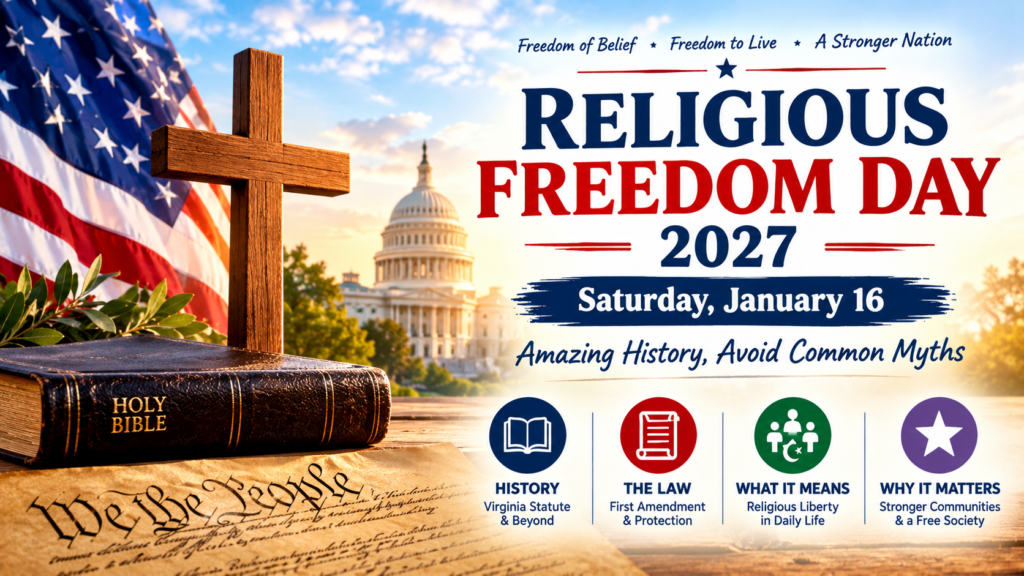
Religious Freedom Day 2027 will be observed on Saturday, January 16, across the United States. The annual observance commemorates a landmark in American history, the 1786 Virginia Statute for Religious Freedom. It encourages people to reflect on the right to follow their beliefs, practice a faith, change their faith or choose no religion at all. It also highlights the importance of protecting freedom of conscience for everyone.
This guide covers the date, the history behind the observance, the First Amendment, what religious freedom means in everyday life and ways to mark the day. It is an educational overview, not legal advice. If you are exploring other U.S. civics topics, see our Bill of Rights Day 2026 guide.
Quick answer: Religious Freedom Day is observed every January 16 in the United States. In 2027, it falls on Saturday, January 16. It commemorates the Virginia Statute for Religious Freedom, enacted on January 16, 1786.
When Is Religious Freedom Day 2027?
Religious Freedom Day 2027 is on Saturday, January 16, 2027.
- Date: Saturday, January 16, 2027
- Why January 16: The Virginia Statute for Religious Freedom was enacted on this date in 1786
- Type: Annual observance, not a federal public holiday
- Not to be confused with: International observances focused on religious freedom or human rights, which fall on other dates
Because it falls on a Saturday, it is a good day for a family conversation, a library visit or a short civics lesson.
What Is Religious Freedom Day?
Religious Freedom Day is a day to recognize freedom of belief, conscience, worship and religious expression. Religious liberty protects people of many faiths, and it also protects people who do not identify with any religion.
History of Religious Freedom Day
The Virginia Statute for Religious Freedom
The statute was enacted in 1786. Its purpose was to protect individual conscience and to oppose forcing anyone to support a church or religious belief.
Thomas Jefferson and James Madison
Thomas Jefferson drafted the statute, and James Madison played a key role in advancing it through Virginia’s legislature. It would be a mistake to say that one law alone created every American religious-freedom protection. It was an influential step in a longer story.
How the Statute Influenced the First Amendment
The Virginia statute helped shape thinking about religious liberty in the early republic. The First Amendment, ratified in 1791 as part of the Bill of Rights, includes the religion clauses that protect against government establishment of religion and government interference with religious exercise.
How January 16 Became Religious Freedom Day
Virginia’s General Assembly formally designated January 16 as Religious Freedom Day in 1986, on the statute’s 200th anniversary. Presidential proclamations have also recognized the observance over the years.
What Does Religious Freedom Mean?
In plain language, religious freedom includes:
- The freedom to practice a religion
- The freedom to change or leave a religion
- The freedom to express religious beliefs, subject to applicable laws
- The freedom to hold no religious belief
- Protection against government establishment of religion and against government interference with religious exercise
The Establishment Clause
This clause limits the government from establishing an official religion or officially endorsing one.
The Free Exercise Clause
This clause protects religious practice from prohibited government interference.
Religious Freedom and Freedom of Conscience
Liberty also means respecting other people’s right to disagree or make different choices. Freedom of conscience works best when it applies to everyone.
Why Is Religious Freedom Important?
- It protects individual dignity and conscience.
- It supports peaceful coexistence in a diverse society.
- It helps reduce religious discrimination and coercion.
- It protects minority faiths and nonreligious people.
- It supports open discussion, civic participation and equal treatment under the law.
Religious freedom protects personal belief and practice, but it does not mean every action described as religious is automatically exempt from all laws. Courts weigh these questions case by case.
Religious Freedom in Everyday American Life
- People choosing where and how to worship
- Wearing religious clothing or symbols, subject to applicable legal rules
- Observing religious holidays and dietary practices
- Students expressing personal religious beliefs in ways protected by law
- People respectfully disagreeing about religion or choosing not to discuss it
Religious Expression in Public Schools
There is an important distinction between private student expression and school-sponsored religious activity. Public schools may not compel students to pray, and they may not discriminate against private religious expression. Because guidance can change, check the current federal education guidance rather than relying on older summaries.
How to Celebrate Religious Freedom Day 2027
- Read the First Amendment and discuss its meaning.
- Explore the Virginia Statute for Religious Freedom.
- Organize a classroom civics discussion about liberty and responsibility.
- Learn about different faiths and nonreligious worldviews from reliable sources.
- Attend a community conversation or educational event.
- Share a respectful message about freedom of conscience.
- Reflect on how to respond to religious discrimination or bullying.
Participation should always be voluntary and respectful of people with different beliefs. To keep the civics theme going, our Constitution Day 2026 guide covers the founding document itself. If you like discussing history with others, communities such as r/AskHistorians on Reddit are a good place to ask questions.
Religious Freedom Day Facts
- Religious Freedom Day is observed on January 16.
- The date commemorates a Virginia law enacted in 1786.
- Thomas Jefferson drafted the Virginia statute.
- The law helped shape the development of religious liberty in the United States.
- The First Amendment includes both the Establishment Clause and the Free Exercise Clause.
- Virginia formally designated January 16 as Religious Freedom Day in 1986.
- Religious liberty concerns people of all faiths and people with no religious affiliation.
Frequently Asked Questions About Religious Freedom Day 2027
When Is Religious Freedom Day 2027?
It is Saturday, January 16, 2027, observed annually in remembrance of the Virginia Statute for Religious Freedom.
What Does Religious Freedom Day Mean?
It recognizes the importance of freedom of conscience, belief, worship and religious expression, and encourages people to understand and protect these rights for everyone.
Why Is Religious Freedom Day Celebrated on January 16?
January 16 marks the date in 1786 when Virginia enacted the Statute for Religious Freedom, drafted by Thomas Jefferson. The law influenced the development of religious liberty protections in the United States.
Who Established Religious Freedom Day?
Virginia’s General Assembly formally designated January 16 as Religious Freedom Day in 1986, 200 years after the statute was enacted.
What Does the First Amendment Say About Religious Freedom?
It prohibits Congress from establishing religion or prohibiting its free exercise. These protections are commonly called the Establishment Clause and the Free Exercise Clause.
Does Religious Freedom Protect People Who Do Not Believe in Religion?
Yes. Religious liberty covers people who hold religious beliefs, change their beliefs or choose not to follow a religion. Government neutrality is part of protecting freedom of conscience.
Is Religious Freedom Day a Federal Holiday?
No. It is an annual observance, not a federal public holiday that closes government offices or schools.
How Can Students Celebrate Religious Freedom Day?
Students can study the First Amendment, research the Virginia statute, discuss historical examples of religious liberty and learn how to respect classmates with different beliefs. Activities should be inclusive and voluntary.
Countdown to Religious Freedom Day 2027
Saturday, January 16, 2027
83 days to go (calculated from October 25, 2026).
Browse more seasonal guides on our homepage. To read more about the legal concept, the freedom of religion article on Wikipedia is a helpful starting point.