
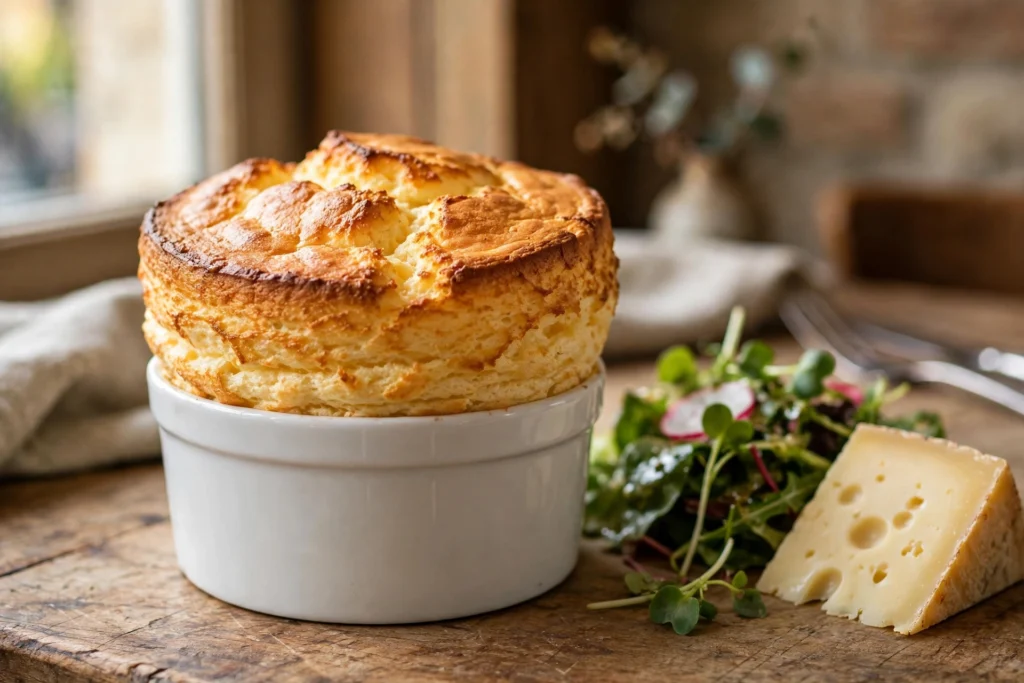
National Cheese Souffle Day 2027 falls on Tuesday, May 18, 2027. It is the one day of the year set aside for the cheese souffle, the classic French dish that rises like a golden cloud in the oven and has been impressing dinner guests since the 1700s. This guide gives you the exact date, a live countdown, the story of how the souffle went from a French royal kitchen to American home ovens, a classic Gruyere recipe you can actually make, and the fixes for the one problem every cook fears: the souffle that falls.
Countdown to National Cheese Souffle Day 2027
Loading…
until Tuesday, May 18, 2027 at 12:00 AM Eastern Time
When Is National Cheese Souffle Day 2027?
National Cheese Souffle Day 2027 is on Tuesday, May 18, 2027. The date is fixed on May 18 every year, so only the weekday changes. It is not a public or federal holiday in the United States, so schools, offices and shops stay open, but restaurants, cheese shops and home cooks mark it with souffle specials and baking nights.
From the day this guide was published, November 22, 2026, there are 177 days until National Cheese Souffle Day 2027. May 18, 2027 also carries another observance on this site: International Museum Day 2027 falls on the same Tuesday, so the day pairs well with a museum visit followed by a souffle dinner.
| Year | Date | Day of the week |
|---|---|---|
| 2026 | May 18 | Monday |
| 2027 | May 18 | Tuesday |
| 2028 | May 18 | Thursday |
| 2029 | May 18 | Friday |
| 2030 | May 18 | Saturday |
What Is a Cheese Souffle?
A cheese souffle, or souffle au fromage in French, is a baked egg dish built from two parts: a rich cheese sauce and stiffly beaten egg whites folded into it. The sauce gives the souffle its flavour, and the egg whites give it its lift. In the heat of the oven, the air trapped in the whites expands and the souffle climbs well above the rim of its dish, golden on top and soft and creamy inside.
The name says exactly what the dish does. Souffle comes from the French verb souffler, which means to puff up or to blow. A souffle is usually baked in a straight-sided dish or in individual ramekins, the small round porcelain cups that are the classic home presentation. It is served as a light main course, a starter, or a side dish, and it must be eaten the moment it leaves the oven, because it begins to sink within minutes. That urgency is part of the charm: a souffle waits for no one.
Cheese is the original savoury souffle filling. Sweet souffles came later, with chocolate, lemon and fruit versions, and they have their own day: National Chocolate Souffle Day falls on February 28. The May 18 celebration belongs to the savoury original. According to National Day Calendar, the most popular cheeses for a souffle are Gruyere, Parmesan, Cheddar, Provolone and Fontina, and just about any cheese can work, with herbs and spices added to taste.
The History of the Cheese Souffle
The cheese souffle has one of the longest documented histories of any dish on the American food calendar. It began in French royal kitchens, moved into the first Paris restaurants, crossed the Atlantic on fine-dining menus, and finally reached American home kitchens in the 1940s and 1950s. The timeline below follows that journey.
| Year | What happened |
|---|---|
| 1742 | The first souffle recipe appears in print in Vincent La Chapelle's Le Cuisinier Moderne. His omelette souffle used sweet and savoury ingredients, including candied lemon peel and veal kidney. |
| 1783 | Antoine Beauvilliers opens La Grande Taverne de Londres in Paris, the first high-end Parisian restaurant, with several souffles on the menu. He is often called the inventor of the souffle. |
| 1813 | The word souffle first appears in English, in Louis Ude's The French Cook, which contains six souffle recipes. |
| 1815 | Marie-Antoine Careme publishes Le Patissier Royal Parisien, with detailed souffle recipes. Careme, the first celebrity chef, is credited with perfecting and popularising the dish. |
| 1841 | Souffle recipes become more common across France as chefs develop more technical versions of the dish. |
| Early 1900s | Souffles become a fixture of fine dining in the United States. The New York Public Library menu archives show them on special-occasion menus at the Waldorf Astoria, the Biltmore and the Hotel Astor. |
| 1940s-1950s | Cheese souffles reach American home kitchens, helped by chefs and cookbook writers including Julia Child and Irma S. Rombauer. |
| 1954 | The souffle gets a film moment in Sabrina, when a master chef scolds Audrey Hepburn's character for trying to make souffles without turning on the oven. |
| 1979 | Cafe Jacqueline opens in San Francisco, a restaurant built around souffles, marking the peak of the dish's American popularity. |
One change in kitchen technology made the modern souffle possible. Careme cooked with updated ovens heated by air drafts rather than coal, which gave cooks the steady, even heat a souffle needs to rise reliably. Before that, souffles were baked inside a pastry case called a croustade, which was removed and not eaten. The air-heated oven let the souffle rise straight out of its dish, and the dish we know today took shape. National Today lists the same milestones, from La Chapelle in 1742 to Cafe Jacqueline in 1979.
The day itself has no documented founder. Like many American food holidays, National Cheese Souffle Day appears on the food calendar without a proclamation or a named creator on record. What is documented is the date: May 18, every year.
How a Cheese Souffle Rises
A souffle looks like magic, but the science is simple. Four things happen in sequence:
- The foam forms. Whipping egg whites forces air into the egg proteins. The proteins unfold and stretch around the air bubbles, building a foam that can hold its shape.
- The base carries the flavour. A bechamel, the classic French white sauce of butter, flour and milk, is mixed with egg yolks and grated cheese. This thick base gives the souffle body, so it is more than just air.
- Heat expands the air. In a hot oven, the air bubbles in the foam expand and steam forms inside them. The souffle climbs up the straight sides of the dish, helped by the butter and cheese coating that gives the batter something to grip.
- The structure sets. The egg proteins firm up in the heat and hold the risen shape, at least for a while. As soon as the souffle cools, the air contracts and the souffle sinks. That is why it is served immediately.
Understanding those four steps explains every rule in the recipe below: whites beaten to stiff peaks, a base that is warm rather than hot when the whites go in, a well-buttered dish, and an oven door that stays shut.
Classic Cheese Souffle Recipe
This is the classic French cheese souffle, built on a Gruyere bechamel and baked in individual ramekins. It serves four as a main course or six as a starter, takes about 55 minutes from start to table, and uses ingredients most kitchens already have. The method follows the standard technique taught in French cooking classes and set out in detail by The Kitchn: bechamel first, yolks and cheese next, whites folded in last, and no peeking while it bakes.
Ingredients
- Softened butter and finely grated Parmesan, for coating the ramekins
- 3 tablespoons unsalted butter
- 3 tablespoons all-purpose flour
- 1 cup whole milk, warmed
- 4 large egg yolks
- 5 large egg whites, at room temperature
- 1 1/4 cups finely grated Gruyere cheese
- 2 tablespoons finely grated Parmesan cheese
- 1/4 teaspoon cream of tartar
- Salt, white or black pepper, a pinch of nutmeg and a pinch of cayenne, to taste
Method
- Prepare the dishes. Heat the oven to 375 degrees F (190 degrees C). Butter four 1 1/4-cup ramekins generously and dust the insides with Parmesan, tapping out the extra. Set the ramekins on a baking sheet.
- Make the bechamel. Melt the butter in a saucepan over medium heat. Whisk in the flour and cook for about 2 minutes, stirring constantly, until smooth and glossy. Do not let it brown. Add the warm milk in three parts, whisking until smooth each time, and cook until the sauce is thick enough to hold a trail from the spatula.
- Add the yolks and cheese. Take the pan off the heat. Whisk in the egg yolks one at a time, then fold in the Gruyere and the Parmesan with the salt, pepper, nutmeg and cayenne. Let the base cool until it is warm to the touch, not hot.
- Whip the whites. In a clean, dry bowl, beat the egg whites with the cream of tartar until they form stiff, glossy peaks. Any trace of fat or yolk in the bowl will stop the whites reaching their full volume.
- Fold, do not stir. Whisk a quarter of the whites into the cheese base to loosen it, then fold in the rest in two additions with a stiff spatula, cutting down through the middle and lifting the batter over. A few small lumps of white are fine. Overmixing knocks the air out.
- Bake without peeking. Fill the ramekins to about 1 cm below the rim and wipe the inside rim clean. Bake for 25 to 30 minutes, until puffed, deep golden on top, and jiggling only slightly in the centre. Do not open the oven door for the first 20 minutes. Serve immediately.
For one large souffle: use a 6-cup souffle dish instead of ramekins and bake for 35 to 40 minutes at the same temperature. What to serve with it: a simple green salad with a sharp vinaigrette, crusty bread, and a glass of dry white wine. The salad cuts the richness, and the bread is for the creamy centre.
Which Cheese Is Best for a Cheese Souffle?
The cheese is the single most important choice in a souffle, because it decides both the flavour and whether the dish rises properly. The rule is simple: firm, aged, low-moisture cheese works, and soft, wet cheese does not. Excess water and oil from a soft cheese weigh down the delicate egg structure and cause the collapse every cook dreads.
| Group | Cheeses | Why |
|---|---|---|
| Best choice | Gruyere, Comte, Emmental, aged sharp Cheddar | Firm and aged, they melt smoothly without releasing excess oil or water, with a robust, nutty flavour. |
| Good in a blend | Parmigiano-Reggiano, Pecorino, Provolone, Fontina | Excellent for a flavour boost. Use about one quarter of these alongside three quarters of a best-choice cheese. |
| Avoid for a classic rise | Fresh mozzarella, Brie, feta, goat cheese | Too much moisture, too much fat, or a cheese that does not melt smoothly. They weigh the souffle down. |
Gruyere is the classic for a reason: nutty, savoury and an ideal melter. If Gruyere is hard to find, aged sharp Cheddar is the best substitute, and Comte is the closest French cousin. Grate the cheese yourself. Pre-shredded cheese is coated with anti-caking agents that can stop the sauce going smooth.
10 Ways to Celebrate National Cheese Souffle Day 2027
You do not need to be a French chef to mark the day. These ten ideas cover the kitchen, the table and the town:
- Bake the classic recipe above. Make it for dinner on Tuesday, May 18, 2027, and invite the table to be seated before the souffle comes out of the oven.
- Try a variation. Swap the Gruyere for aged Cheddar with a spoonful of Dijon mustard, or fold in sauteed spinach, mushrooms or chopped herbs. The base technique stays the same.
- Order one at a restaurant. French bistros and fine-dining restaurants often put a cheese souffle on the menu. Call ahead, because many kitchens make it to order and need notice.
- Make it a cheese tasting. Buy small pieces of Gruyere, Comte, aged Cheddar and Fontina, taste them side by side, and vote on which one goes into the souffle.
- Bake with kids. Whipping the egg whites and watching the souffle rise through the oven window is one of the best kitchen-science lessons a child can get.
- Host a souffle supper. One souffle per couple, a green salad, crusty bread and a simple dessert. The dish does the entertaining for you.
- Try the twice-baked version. Bake individual souffles, let them cool, then reheat them with cream the next day. See the section below.
- Take a French cooking class. Many cooking schools run souffle classes, and the technique is easier to learn by watching once than by reading ten times.
- Share a photo. Post your risen souffle with the hashtag #NationalCheeseSouffleDay. The best photos are taken in the first minute, before the sink begins.
- Pair the day with its neighbour. May 18, 2027 is also International Museum Day, so a museum visit in the afternoon and a souffle dinner in the evening makes a full day of it. The May 17 neighbours on this site, National Walnut Day and National Mushroom Hunting Day, round out a food-filled weekend.
Why Did My Cheese Souffle Fall?
Every souffle sinks a little after it leaves the oven. That is normal. A souffle that collapses into a flat, dense layer has a specific cause, and most of them are easy to fix next time.
| What went wrong | Why it happened | The fix |
|---|---|---|
| The souffle never rose much | Whites were underbeaten, or the base was too hot when they were folded in and cooked them on contact | Beat whites to stiff, glossy peaks. Let the cheese base cool to warm to the touch first. |
| It rose, then sank fast | The oven door was opened early, dropping the temperature by 25 to 50 degrees in an instant | Do not open the door for the first 20 minutes. Use the oven light to check. |
| It rose lopsided | A spot on the dish was not buttered, so the batter could not climb evenly, or a drip on the rim held it back | Butter every part of the dish and wipe the inside rim clean before baking. |
| The texture is heavy and wet | A soft, high-moisture cheese was used, or the whites were overmixed and the air was knocked out | Use a firm, aged cheese. Fold gently and stop while a few lumps of white remain. |
| The whites would not whip up | Fat in the bowl, from yolk, butter or a greasy beater, stops the foam forming | Use a clean, dry bowl and beaters. Separate the eggs over a separate small bowl so no yolk slips in. |
One comfort for first-timers: even a fallen souffle tastes good. The cheese, butter and eggs are all still there. It will be a delicious cheesy pudding rather than a towering cloud, and the next attempt will be better.
Twice-Baked Cheese Souffle: The Make-Ahead Answer
The classic souffle cannot wait, which makes it awkward for a dinner party. The twice-baked version solves that problem, and it is the version popularised by Nigella Lawson. Bake the souffles in ramekins as above, let them cool completely, then turn them out onto a baking dish. They will sink, and that is expected. When you are ready to serve, pour a little cream over each one and bake at 400 degrees F (200 degrees C) for about 12 minutes, until puffed and golden again. The second rise is smaller and less dramatic, but the texture is rich and silky, and the whole dish can be prepared a day ahead. The cheese base itself can also be made up to a day in advance: cover it with plastic wrap pressed directly onto the surface, refrigerate, and bring it back to room temperature before folding in freshly whipped whites.
Frequently Asked Questions About National Cheese Souffle Day 2027
When is National Cheese Souffle Day 2027?
National Cheese Souffle Day 2027 is on Tuesday, May 18, 2027. The date is fixed on May 18 every year.
How many days are there until National Cheese Souffle Day 2027?
There are 177 days from November 22, 2026 until Tuesday, May 18, 2027. The live countdown at the top of this page ticks down to midnight Eastern Time at the start of May 18.
What is a cheese souffle made of?
A cheese souffle is made from a bechamel base of butter, flour and milk, mixed with egg yolks and grated cheese, usually Gruyere, and then folded with stiffly beaten egg whites. The whites provide the lift, and the cheese provides the flavour.
What cheese is best for a cheese souffle?
Gruyere is the classic choice, with Comte, Emmental and aged sharp Cheddar close behind. Firm, aged, low-moisture cheeses melt smoothly without weighing the souffle down. Soft cheeses such as fresh mozzarella, Brie, feta and goat cheese are best avoided in a classic souffle.
Why does my cheese souffle fall?
Some sinking is normal: the air in the souffle contracts as it cools. A full collapse usually means the whites were underbeaten or overmixed, the cheese base was too hot when the whites went in, the oven door was opened too early, or a soft, wet cheese weighed the structure down.
Can I make a cheese souffle ahead of time?
The cheese base can be made up to a day ahead and refrigerated, with plastic wrap pressed onto the surface. The egg whites must be whipped and folded in just before baking, because a baked souffle cannot be stored in its risen state. The twice-baked version is the practical make-ahead option for a dinner party.
Is National Cheese Souffle Day the same as National Chocolate Souffle Day?
No. National Chocolate Souffle Day falls on February 28 and celebrates the sweet version. National Cheese Souffle Day, on May 18, celebrates the savoury original.
Is National Cheese Souffle Day a public holiday?
No. It is a food observance, not a federal or state holiday. Schools, offices and shops stay open, and there are no verified 2027 restaurant deals or promotions announced as of November 22, 2026. Check with local French restaurants and cheese shops closer to May 18, 2027 for any specials.
National Cheese Souffle Day 2027 is a small holiday with a long history, from a printed recipe in 1742 to a Tuesday dinner table in 2027. Whether you bake the classic Gruyere version, order one at a bistro, or simply learn why it rises and why it falls, the day is a good excuse to try the dish that French chefs have been perfecting for nearly three centuries. If you enjoy food days, see the other May celebrations on this site, including Mother's Day 2027 on May 9, National Chocolate Mint Day 2027, National Pie Day 2027 and National Popcorn Day 2027, or start from the MemorialDay2026.com homepage.